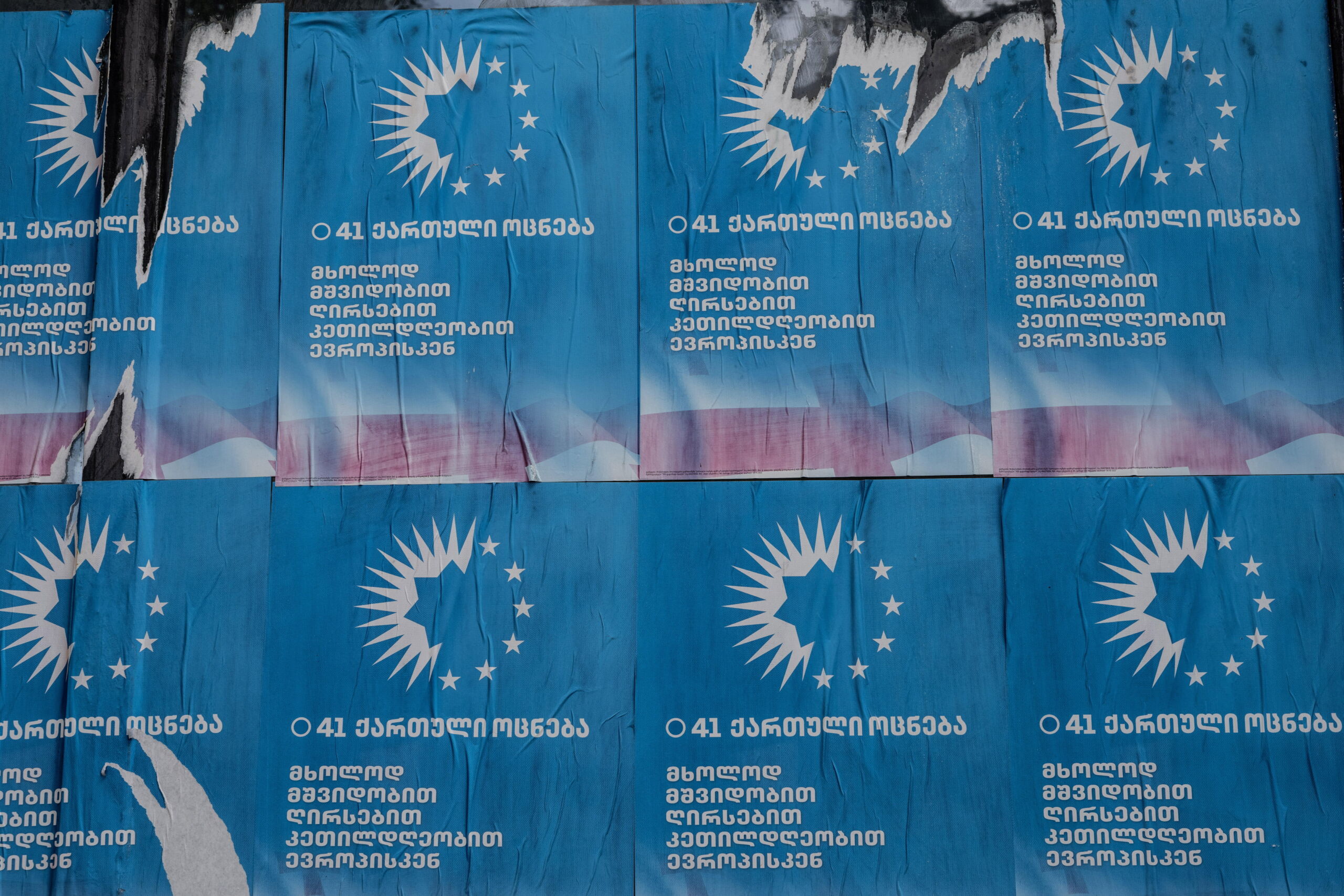
Posters promoting the Georgian Dream party currently in power on display along Stalin Avenue, Gori city. picture alliance / Sipa USA | SOPA Images
Georgia: Authorities must end legal and regulatory pressure on critical broadcasters
The International Press Institute (IPI) today raises alarm over growing regulatory and legal pressures against independent television broadcasters in Georgia, which mark another escalation in the playbook of attacks on press freedom.
As hostility from the Russia-friendly Georgian Dream government toward media increases through the use of non-independent regulatory bodies, IPI renews our call for urgent action by the international community to safeguard what remains of media freedom.
On 25 June, Georgia’s media regulator, the Georgian National Communications Commission (GNCC), imposed a fine of GEL 2,500 (€830) on the critical broadcaster TV Pirveli, citing alleged breaches of editorial standards and violation of the principles of fairness and impartiality during numerous news broadcasts.
Among the phrases TV Pirveli was sanctioned for was referring to jailed anti-government protesters as “prisoners of conscience” and the description of Bidzina Ivanishvili, the billionaire founder of the ruling Georgian Dream party, as an “oligarch”.
On 21 May, the GNCC imposed an identical fine on another critical television broadcaster, Formula TV. The station was sanctioned for its use of language, including questioning the legitimacy of the Georgian Dream government, as well as the term “prisoners of conscience” and language used to describe pro-government television channels.
The GNCC levied the fines against the two broadcasters under Article 54(5) of the Law on Broadcasting and the Code of Conduct for Broadcasters. The law was amended by the ruling Georgian Dream in 2025.
Under the changes, the GNCC was granted the authority to enforce standards previously addressed under a framework of self-regulation by the journalistic community. The amendments expanded the powers of the GNCC to regulate impartiality, accuracy, fairness and privacy. The GNCC also granted powers to issue penalties of up to 3% of annual revenue or even revoke a broadcaster’s license for breaching the new rules.
At that time IPI demanded repeal of the amendments, arguing that they would empower the GNCC to act as the government’s censor to silence critical media outlets. If one of the broadcasters is now identified by the regulator as having committed a repeat offence, the GNCC has the power to initiate proceedings to revoke the broadcast license of the media outlets. The recent fines came after the GNCC announced in March that it would start enforcing the Law on Broadcasting more robustly.
The independence of the GNCC has long been questioned. A fact-finding mission conducted by MFRR and CoE Safety of Journalists Platform in October 2024 raised concerns over GNCC’s insufficient independence from the government and application of punitive fines against media.
The amendments to the Law on Broadcasting are among several restrictive laws adopted by the Georgian parliament following highly contested parliamentary elections in 2024. Since the elections, Georgia has experienced one of the most rapid and serious deteriorations of press freedom ever seen in an EU member state or candidate country, according to IPI monitoring.
Criminal investigation
In addition to disproportionate and discriminatory regulatory actions, fresh concerns have arisen in recent weeks over the use of criminal law against media outlets critical of the government.
On June 17, the Prosecutor’s Office of Georgia announced the launch of a criminal investigation against Formula TV on charges of “false denunciation”, an offense which carries a potential fine, community service, corrective labour, or imprisonment for up to four years.
The investigation was launched based on a complaint by a film director and well-known supporter of the ruling party over a report aired by Formula TV in January which included allegations of wrongdoing by the director. Following the airing of the report, Davit Kashiashvili, the report’s author and prominent anchor at the broadcaster, received threats on social media.
According to Formula TV’s lawyers, this is the first precedent of a criminal probe launched against an independent broadcaster in Georgia. On June 26, the Prosecutor’s Office questioned the station’s journalist Kashiashvili as part of the ongoing criminal case.
A separate civil defamation dispute between the film director and the Formula TV company is currently ongoing in which the plaintiff is seeking compensation for moral damages over harm to his honor and dignity.
IPI demands that the Georgian prosecutors consider the public interest nature of the report, discontinue the criminal investigation against Formula TV, and respect the confidentiality of journalistic sources.
IPI further urges Georgian authorities to cease the imposition of discriminatory or disproportionate fines against broadcasters for using contested language under the amended broadcasting law, and to respect public debate and freedom of expression.
This statement was coordinated by IPI as part of the Media Freedom Rapid Response (MFRR), a Europe-wide mechanism which tracks, monitors and responds to violations of press and media freedom in EU Member States and Candidate Countries.
This statement was coordinated by the Media Freedom Rapid Response (MFRR), a Europe-wide mechanism which tracks, monitors and responds to violations of press and media freedom in EU Member States, Candidate Countries, and Ukraine. The project is co-funded by the European Commission.