 Library
Hungary: Media freedom reform must be priority for incoming…
Hungary: Media freedom reform must be priority for incoming Tisza government
Media reform in Hungary must be a priority issue for the new Tisza government as it seeks to rebuild the country’s severely eroded checks and balances and rejoin the European Union’s democratic community, the undersigned partners of the Media Freedom Rapid Response (MFRR) said today following the election result.
15.04.2026
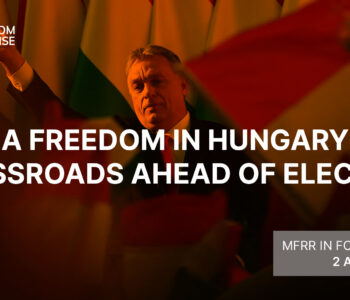
The end of the 16-year rule of Prime Minister Viktor Orbán’s Fidesz party, under which Hungary plummeted to become the European Union’s worst country for media freedom, offers a historic opportunity for a democratic reset and a new era for media after a decade-and-a-half of sustained deterioration.
Just as the Orbán government’s crackdown on the press paved the way for increasing autocratisation and corruption, reforms to improve media freedom and revitalise media pluralism will be central to the success for the Tisza government’s wider re-democratisation and transparent governance efforts moving forward. As the country charts a course towards a more European future, MFRR partners call on the new government of Prime Minister Peter Magyar to ensure that fundamental media reforms are at the core of this democratic transformation.
To support this process, MFRR partners today call for the establishment by parliament of an independent and high-level multistakeholder task force on media reform, which should develop a comprehensive strategy for constitutional, legislative, and regulatory change, in line with EU commitments, regulations and laws. This strategy should be developed with meaningful and inclusive input from media experts, journalists’ organisations and civil society.
Key priorities for this reform of the country’s media landscape must include efforts to support the regeneration of media pluralism; laws to limit media concentration; systemic reform of public media to guarantee independence; overhaul of the country’s media regulatory system and management; readjustment of the media market through the end of abuse of state advertising to media; and the repealing of restrictive laws such as Sovereignty Protection Act and the dismantling of the Sovereignty Protection Office.
These policies should be combined with accountability for spyware and other types of surveillance of journalists; cessation of smear campaigns and abusive language against press by government politicians; improvement of the climate for access to information for journalists; the end of discriminatory accreditation and interview practices, and the strengthening the legal climate and creation of protections against abusive lawsuits.
Tisza’s election manifesto made several pledges on addressing state propaganda and reforming the country’s media institutions. Most prominently, these include changes to media regulator management, a temporary suspension to the public media news broadcasting until reforms ensuring independence are implemented, and a temporary moratorium on state advertising in the media. While these proposals offer some positive signs, such reforms will require a robust and detailed strategy, which should be developed in close consultation with media, journalists’ organisations, civil society and policy communities.
After more than 15 years of the steady erosion of media freedom and pluralism in Hungary, MFRR partners stress that the process for unwinding media capture in the coming months and years will be complex and challenging. Despite the two-thirds constitutional majority secured in parliament, the Tisza government will likely face hurdles and obstruction in changing a media system built by Fidesz to withstand reform. While a major overhaul is required, it is important that reforms are carried out through lawful, proportionate and democratic means, with the aim of regenerating media pluralism, restoring local, regional and national media markets, and ensuring an enabling environment for independent journalism. We also urge the new leadership to ensure that its communication practices regarding the press foster an environment that enables free and independent journalism.
The ability of Tisza to unwind media capture, safeguard independent journalism and re-democratise the country’s media will be a crucial test for the new government’s rule of law agenda, but could also offer an example for positive media freedom reform for the European Union and beyond. The new government has the crucial constitutional majority required to do so. The focus must now be on how to make immediate media freedom progress, but also how to introduce the safeguards required to ensure Hungary can never experience similar media crackdowns in the future.
At the beginning of this historic democratic re-opening, MFRR partners stand ready to support the development of media reforms and to provide recommendations for improving media freedom in line with international standards and EU frameworks, most prominently the European Media Freedom Act (EMFA). In the coming months, our organisations are also committed to visiting Budapest to meet with the new leadership and government ministries to provide expert input on the path ahead.
- Since April 2020, the MFRR’s Mapping Media Freedom (MapMF) platform has registered 213 different press freedom violations in Hungary, targeting 886 journalists and media actors. These include smear campaigns, blocked access to reporting locations, surveillance and spyware, SLAPPs and other legal pressures, editorial interference and many others. Most of these incidents were conducted by the government officials and/or other public authorities (98 in total).
- Click here to access more of the MFRR’s advocacy and reports on media freedom in Hungary
- MFRR statement: Espionage charges against investigative journalist Szabolcs Panyi ahead of elections mark another dangerous step toward Orbán’s authoritarian rule
- Ahead of the election, the International Press Institute (IPI) and the MFRR organised a webinar which gathered leading Hungarian media experts to discuss the diverging paths ahead for media freedom after the vote and to discuss the priorities for media reform. You can watch the online discussion here.
This statement was coordinated by the Media Freedom Rapid Response (MFRR), a Europe-wide mechanism which tracks, monitors and responds to violations of press and media freedom in EU Member States and Candidate Countries.