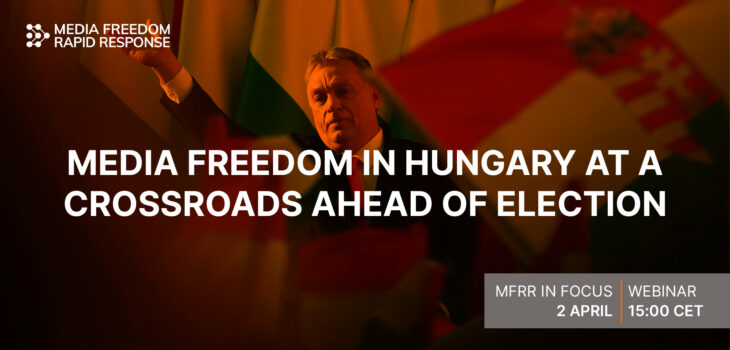
Media freedom in Hungary at a crossroads ahead of election
2 April, 15:00 CET
As the general election approaches on 12 April 2026, the fate of media freedom in Hungary stands at yet another major crossroads.
If the Fidesz party of Prime Minister Viktor Orbán triumphs again, leading officials have already threatened to “complete” the job of driving “pseudo journalists” and media organisations which receive foreign funds out of the country. After 15 years of the dramatic erosion of press freedom and media pluralism, another four years of authoritarian rule would likely see the space for independent journalism shrink further, and the potential return of a previously shelved foreign funding bill.
If the opposition party led by challenger Péter Magyar wins, his Tisza party has pledged in their manifesto to carry out major media reforms to address “state propaganda” and “disinformation”, including by adopting a new media law, reforming media regulatory bodies, suspending public media news broadcasting after taking office until reforms are carried out, and putting a temporary moratorium on state advertising in media.
Taken together, the opposition’s reform agenda appears aimed at breaking the government monopoly on information in Hungary’s media ecosystem. However, in a media landscape future proofed by Fidesz against major structural reform, there are already growing concerns that the measures used to do so by a Tisza government could bring their own risks and face major legal and political challenges.
In this one-hour session on 3 April, the International Press Institute (IPI) and the Media Freedom Rapid Response (MFRR) will bring together leading Hungarian media experts and journalists to analyse these diverging paths post-election and discuss different recommendations for long-term, democratic reform.
On the panel, we’ll hear from the authors of a new report by the Rule of Law Lab at New York University School of Law, in collaboration with Hungarian watchdog Mérték Media Monitor, which analyses 15 years of Fidesz’s playbook for repressing independent media.
The International Press Institute (IPI) will also present its blueprint for media reform in Hungary, featuring key recommendations for regenerating media freedom and pluralism in the country.
Moderator

Jamie Wiseman
Senior Europe Advocacy Officer, International Press Institute (IPI)
Speakers

Bea Bodrogi
Hungarian media law expert and expert advisor at the Rule of Law Lab at New York University School of Law

Dr. Gábor Polyák
Professor and head of the Department of Media and Communication at Eötvös Loránd University, senior researcher of Mertek Media Monitor
Flora Garamvolgyi
Hungarian-American global affairs reporter for The Guardian