Library

Wiretapping and trojans: The Nordio bill alarms journalists

Wiretapping and trojans: The Nordio bill alarms journalists

For the Italian Press National Federation and trade associations, the crackdown on the dissemination of transcripts is a new attack on freedom of the press and citizens’ right to be informed. Even MPs are in turmoil, worried that the “cyber interceptor” – aka trojan – will get out of the hands of its users.

By Paola Rosà

Originally published by OBCT. Also available in ITA

“The regulatory system already provides for a series of filters that do not allow the publication of wiretaps that are not relevant to the investigation, which are appropriately kept in a special archive”: this is what we read in the six pages   of the memorandum that the FNSI (Italian Press National Federation) handed over months ago to the Senate Justice Committee during the fact-finding investigation on the subject of wiretapping. It was April 27th and the public discussion on the topic – a “hot” topic for decades – was centred on the apparently intransigent, but often contradictory position of Minister of Justice Carlo Nordio: for months the former magistrate from the right-wing government party had announced “a profound review of the discipline” on wiretapping as a “deadly instrument of personal and often political delegitimisation” as well as “a barbarism that costs 200 million Euros a year”.


The announcements in the press, accompanied by dramatic backtracks on the alleged abolition of wiretaps even in cases of mafia and terrorism (because “mafiosi don’t talk on the phone”), and filled with attacks on the categories of journalists and magistrates, continued until the beginning of August, when the final version of the bill – which does not abolish wiretapping for mafia and terrorism crimes but rather broadens its scope – was approved by the Council of Ministers, thus starting its parliamentary process after the summer break.


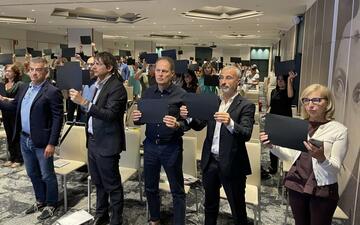
Already in April however, and then also at the beginning of July during a flashmob   against “the gag of the Nordio bill”, the journalists’ union wanted to remind MPs of their “task of balancing the interests at stake, of finding the right balance between two constitutional principles. The one relating to the right to privacy and the protection of the dignity and honourability of people and the one relating to the right to inform and be informed, the cornerstone of our democratic system as the Constitutional Court has reminded us several times with two twin sentences on article 21 and as the President of the Republic often reminds us”.


In fact, what concerns journalists – and what should concern the whole of society considering the role of information in conveying events of general interest – are the new restrictions on the dissemination of wiretaps: the Nordio bill expands the prohibitions already introduced by previous regulations, such as the Orlando reform, and allows wiretaps to be disseminated only if already reproduced by the judge in the motivation and used during the trial.


The issue, however, is even more complex and does not only concern the limitation of the instrument and possible further censorship, but at least three scenarios which partly overlap and partly contradict each other: the right of public opinion to know news of general interest, the risk of extending surveillance practices also to subjects not involved in the investigations, and the protection of the privacy of the suspects themselves on personal matters not relating to the investigations.


General interest and media excesses

As FNSI general secretary Alessandra Costante reminded the senators speaking in the Justice Commission in April, once again the legislator seems not to take “into consideration the need to publish and disseminate news of general interest which is a value to be protected, such as affirmed by the European Court on several occasions, regardless of the aspects linked to a person’s guilt”.


It is true that the reference to the ECHR cannot erase decades of abuse and excesses by the Italian media, which have fed readers and viewers private details that are not relevant for the purposes of the investigation. The fact that the justification for a gag is then built on these excesses seems to be the predictable and much heralded response of the government, which wanted to dedicate the reform to Silvio Berlusconi.


But what would have happened if the Nordio bill had been in force, for example, during the investigation into the collapse of the Morandi bridge? Darkness on the managers’ statements regarding the Benetton family. And for the violence in the Verona police station? Video censorship. The concrete examples, illustrated by the FNSI during the flashmob in July, reflect the current reality, whereby according to the code of criminal procedure a copy of the wiretaps, once deposited, can be provided to anyone who is interested, and it is up to the public prosecutor the ensure that no content relating to sensitive personal data is included in the guidelines. The Nordio bill would instead make a clean sweep, eliminating the possibility of publishing the wiretaps if they have not already been reproduced by the judge in the motivation and used in the hearing. Other prohibitions affect the general prosecutor’s office, the judge, and the public prosecutor, who will not be able to report in the minutes or acquire in the excerpt data relating to subjects other than the parties. And this with the understandable aim of protecting “the third party not involved in the proceedings”.


The spectre of Trojans and questions from senators

In the Senate Justice Committee on 24 January  , the president of the Lawful Interception association Elio Cattaneo, who defined the wiretapping sector as “excellence in the hi-tech sector of our country”, gave an overview of the professionals involved, speaking of over 1500 employees – just from its trade association which brings together the six main companies in the sector and which covers 75% of the market. The interception activity takes place 95% on behalf of the Prosecutor’s Office and 5% for the secret services. The main field of application is telephone wiretaps (76%), with 15% environmental wiretaps, 5% computer wiretaps, and 3% Trojans. The data, also available on the ministry’s website  , speak of a declining trend, with a peak of 141,169 interceptions in 2013, while the most recent data referring to 2021 reports 95,379 targets, including 72,769 telephone users, 14,606 environmental interceptions, more than 5,000 computer viruses, and 2,896 trojans, the spy virus that transforms the phone into a microphone that is always on.


The senators’ attention was focused precisely on computer interceptors or Trojans, software with unknown potential, during two hearings last January: questions, requests for clarifications, worried interventions, starting from the president of the commission herself, Northern League senator and lawyer Giulia Bongiorno. The Trojans, the senators were told, are able to send and receive, without the knowledge of the owner of the cell phone in which they are installed, not only calls, messages, and emails, but also audio recreating the owner’s voice. It can activate the camera, take photos, and create videos, read text messages and MMS, access the content of instant messaging (including chats protected by encryption such as WhatsApp, Signal, and others), GPS (therefore the geolocation of the device), and inspect the contents (therefore see the images, videos, and documents present), including the Internet browsing history.


Senators were particularly alarmed when Lelio Della Pietra, a forensic IT consultant, reported a case of “manifest pathologies in the process of acquisition and detention of the sound traces coming from the receiver”. Pathologies which according to the engineer can be cured, and it is “strategic that they be cured as soon as possible, because the credibility of the instrument and all the investigations connected to it is at stake”.


The case described by Della Pietra, dating back to 2019, therefore before the entry into force of the Orlando reform which established a general archive of wiretaps, involved a Trojan which records conversations, but not twenty-four hours a day: its first objective is not to be discovered, therefore “it must try to disguise itself, it must not heat up the device, it must not consume too much battery or too much bandwidth”. For this reason, as an “actively piloted device”, it must be programmed via a specific interface.


The anomalies described by the engineer refer to recordings without programming, “a bit like when in lawsuits it turns out that the rifle fired on its own: in this case the Trojan allegedly recorded on its own. In 22 cases there were then very long periods (entire nights) in which the Trojan was programmed to receive and absolutely nothing arrived; moreover, one of these periods is precisely the key night of the investigations, in which the receiver stops receiving at 2 am, while scheduled for the entire following day”. And then there are also audios that literally disappeared, even though the recording time is known. “They just disappeared.”


Even engineer Paolo Reale, another IT forensic consultant, was equally clear in the hearing   on January 12, hoping that the legislator would find new rules for a new tool like Trojans: “It is clear that that is a completely different tool from the classic telephone interception, with which it has nothing to do; it is an invasive tool that affects practically all aspects of our lives, because today our cell phone contains all information relating to our appointments or our children, so certainly a different regulation would be desirable for this very reason”.


Balance between rights and mass surveillance

“On interceptions using wiretaps – said the president of the Guarantor for the protection of personal data, Professor Pasquale Stanzione, called by the senators to express an opinion – the intrusive potential of these tools requires adequate guarantees”. “If made available on the market, even just by mistake, in the absence of the necessary filters to limit their acquisition by third parties, these spy apps would in fact risk turning into dangerous tools of massive surveillance”.


Between the risk of mass surveillance and the need to guarantee both privacy and the effectiveness of investigations, the issue of wiretapping involves numerous evolving aspects.


“The lighthouse, the line, the main path is the protection of the human person”, added Stanzione, who also recalled European legislation: “We move in a European system which has made personalism the centrality of its legislation. It will be the GDPR, the Digital Services Act, the Artificial Intelligence Act that will move in this perspective (…) because Europe has a middle path precisely towards artificial intelligence, which touches on these enormous profiles of invasion of the intimate sphere of the person. The middle path is neither the unbridled liberalism of the American experience nor the rigid statism, i.e. the Chinese-Korean one, which leaves no room for the fulfillment and free development of the personality, to which our article 2, cited many times, gives guarantee and solid conformation”.


Nicola Canestrini, criminal lawyer and media expert, also insists on this constant search for a balance: despite having recently defended journalists who had published wiretaps (see the case of the acquittal of the authors of an investigative book on the discontent within the South Tyrolean majority party), Canestrini does not address the issue with an absolutist approach. On the contrary. As demonstrated by his appeal to the Strasbourg Court against the wiretaps which saw him as a victim, the lawyer is decidedly cautious.


In 2021, when he discovered transcripts of his phone calls with his client, Canestrini decided to report this violation of the right to privacy, which had revealed the defence strategy to the public prosecutor. There are at least three occasions in which the lawyer found himself reading excerpts of his conversations with his clients in court documents. Hence the appeal to the European Court of Human Rights, in which he contests the mechanism of posthumous verification of compliance with legal limits.


Therefore, there is no absolutism when it comes to wiretapping, but certain reference criteria: case by case, situation by situation, there are times to approve their publication and others to ask for confidentiality, times to privilege respect for human dignity and others to privilege the needs of the investigations – in the constant search for a balance between constitutionally guaranteed rights.

This article was coordinated by the Media Freedom Rapid Response (MFRR), a Europe-wide mechanism which tracks, monitors and responds to violations of press and media freedom in EU Member States and candidate countries. 

MFRR 3 consortium logos
Library

Italy: Support for Roberto Saviano in SLAPP case initiated…

Italy: Support for Roberto Saviano in SLAPP case initiated by Giorgia Meloni

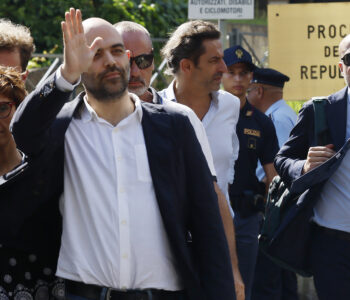
We, the undersigned international media freedom and journalists’ organisations, stand in solidarity with Roberto Saviano as he attended the fourth Court hearing in the SLAPP case initiated by the Prime Minister of Italy on 27 June 2023.

We call on judges to recognise that Saviano has committed no crime and urge Prime Minister Meloni to withdraw her criminal complaint. We further demand that politicians stop abusing the law by initiating strategic lawsuits against public participation (SLAPPs) against journalists, writers and anyone else exercising their right to free expression. We also call on the Italian Parliament to adopt, without further delay, a comprehensive reform of defamation laws in line with international freedom of expression standards.


The lawsuit against Saviano was filed by Giorgia Meloni in November 2021, when she was an MP and prior to becoming Italy’s Prime Minister. The charges of aggravated criminal defamation were brought against Saviano at the behest of Meloni for his critical remarks about Meloni’s long-standing anti-migrant rhetoric which he had expressed during a televised program, Piazza Pulita. Saviano’s remarks followed Piazza Pulita’s coverage of the death of a six-month-old baby from Guinea who was among migrants who drowned in the Mediterranean after Italian authorities delayed their rescue operations.


During the fourth hearing at the Criminal Court of Rome, Piazza Pulita anchorman Corrado Formigli and Amnesty International Italia’s spokesperson Riccardo Noury testified in court. Recalling Amnesty’s report which examined hate speech during the 2018 Italian electoral campaign, Noury testified to the role of Meloni in promoting an anti-migrant narrative articulated around hate and xenophobia. At the conclusion of the hearing, the judge rejected the request formulated by the defence to audit Meloni. Meloni has not appeared in any of the four Court hearings held to date, despite having initiated legal action against Saviano for aggravated criminal defamation claiming his remarks had damaged her honour and reputation. The judge scheduled the next hearing for October 12, 2023, when a first instance sentence is expected to be issued.


Article 595 of the Italian criminal code provides for prison sentences of up to three years for criminal defamation. This law threatens freedom of expression, a fundamental right protected by the Italian Constitution and international law, and hinders journalists and writers from expressing their opinions on matters of public interest. In a democratic society, it is unacceptable for a criminal defamation lawsuit to be used as a weapon to silence critical voices.


Under international freedom of expression standards, the right to freedom of expression encompasses the freedom to express opinions and ideas that may be considered offensive, shocking, or disturbing. Moreover, the ECtHR and domestic courts have clarified that public figures, especially those in political roles, should expect a higher degree of criticism and scrutiny due to their prominent position in society. Criminal prosecution of critics in such cases is deemed to infringe the right to freedom of expression as outlined in Article 10 of the European Convention on Human Rights (ECHR).


The escalating occurrence of vexatious lawsuits targeting journalists in Italy is deeply concerning. Members of the current government are increasingly abusing the law against individuals who express dissenting views. This shows that press freedom and civic space in Italy is shrinking, with dangerous implications for Italy’s democracy.


We acknowledge that a number of bills directed at reforming defamation provisions are currently being discussed by the Italian parliament. We are particularly concerned as the proposed provisions violate international standards on freedom of expression and Article 10 of the ECHR as they substantially increase fines for criminal defamation and impose additional penalties of disqualification from practising the journalistic profession. As the European Court of Human Rights has repeatedly stated, criminal defamation sanctions have a serious chilling effect on freedom of expression.


Comprehensive reforms of defamation laws in Italy must be aligned with international freedom of expression standards and should focus on decriminalising defamation and establishing reasonable limits on damages within civil law to protect press freedom, free expression, and the public’s right to know. Italy should also support the strongest set of anti-SLAPP protections in the forthcoming negotiations over the EU anti-SLAPP Directive.


Our organisations will keep monitoring the current defamation proceedings against Roberto Saviano and will respond to any additional threats to media freedom in Italy.

Signed by:

  • OBC Transeuropa (OBCT)
  • European Centre for Press and Media Freedom (ECPMF)
  • European Federation of Journalists (EFJ)
  • Index on Censorship
  • International Press Institute (IPI)
  • ARTICLE 19 Europe
  • Justice for Journalists Foundation (JFJ)
  • The Daphne Caruana Galizia Foundation
  • Blueprint for Free Speech
  • Meglio Legale
  • The Good Lobby
  • PEN International

This statement was coordinated by the Media Freedom Rapid Response (MFRR), a Europe-wide mechanism which tracks, monitors and responds to violations of press and media freedom in EU Member States and candidate countries.

MFRR 3 consortium logos
Library

Italy: International Media freedom groups raise alarm about RAI’s…

Italy: International Media freedom groups raise alarm about RAI’s independence

Following the recent resignation of the CEO and other major politically-influenced internal management changes at Radiotelevisione Italiana (RAI), the Italian public service broadcaster, the MFRR partners express growing alarm about threats to the editorial independence of the broadcaster.

Following the recent resignation of the CEO and other major politically-influenced internal management changes at Radiotelevisione Italiana (RAI), the Italian public service broadcaster, the undersigned media freedom and journalist organisations today express growing alarm about threats to the editorial independence of the broadcaster. We call on the parliament to initiate a debate aimed at reforming the governance and funding system of RAI and safeguarding its independence.


On May 8, 2023, Carlo Fuortes announced his resignation from the post of CEO of RAI, citing political pressure. The high-profile resignation came amidst reports of behind-the-scenes negotiations between Fuortes and the cabinet involving his appointment as the director of a Napolitan theatre. Within this context, the government issued a decree law which forces the former theatre director into premature retirement


On May 15, Roberto Sergio was appointed as the new CEO of RAI, who swiftly announced the need for “new storytelling” by the broadcaster in a letter to its employees. This was followed by the change, with a minority vote, of five out of the eight RAI channels’ editors-in-chief. We believe these developments put RAI’s editorial independence at serious risk. Sergio’s reference sets the tone for broadcasting programming conformed with the ruling coalition’s agenda. As concerns other management changes, we believe that also the appointment of Giampaolo Rossi as RAI’s new Corporate General Manager is particularly worrying, given his controversial public stances, and risks exacerbating the polarisation of Italian public opinion.


Currently, the Italian broadcasting service’s governance is heavily affected by RAI’s Board appointment mechanism, which testifies to its lack of independence from the executive. Of a total seven Board members, one is elected by RAI employees, and two each by the government, the chamber of representatives and the senate. Following the codification of this appointment mechanism in 2004 (law 111/2004), amended in 2016 (law 220/2015), the composition of the board has reflected cyclical waves of politically-motivated interference in RAI’s governance following elections. As stated in the Council of Europe’s 2012 Recommendation: “without demonstrable independence of action and initiative, from government as well as from any other vested interest or institution, public service media organisations cannot sustain their credibility”. Public broadcasting in the hands of any political forces is not at the service of the public interest, but a tool in their hands which threatens media integrity, an essential condition for the functioning of our democratic societies.


A further source of concern is the bill proposal recently presented by Lega Senator Mara Bizzotto. Part of the government’s coalition, Lega’s proposed amendments threaten to shrink even further the financial autonomy of the Italian broadcasting service. Currently, RAI is funded by citizens through a licence fee plus advertisement. According to Lega’s reform, public broadcasting funding would be subjected to a yearly determination via the Budget Law. While such a legislative amendment might face opposition within the governing coalition, we are nonetheless concerned by Lega’s proposal, which, if passed, would seriously reduce the broadcaster’s financial independence.


Under European freedom of expression standards, RAI as a public service broadcaster should enjoy operational and administrative autonomy from any other person or entity, including the government and any of its agencies. This autonomy shall be respected at all times. The Italian Constitutional Court had made its position clear, arguing that public service broadcasting is to be intended as a “social service” which must “offer the public a range of services characterised by objectivity and completeness of information”, a condition which can be fulfilled by granting adequate powers of oversight to the Parliament (Constitutional Court rulings 94/1987 and 69/2009). 


Joining the dissent expressed by both Italian and European journalists’ associations and unions, the undersigned organisations call on the Italian parliament to initiate a comprehensive reform of the legislation regulating Italian public broadcasters.We urge Italy to bring forward legislation directed to protect public service media from undue interference and guarantee its funding. Such a reform should allow RAI to operate in a sustainable governance framework, with reliable and adequate funding, securing both its editorial independence and public accountability, as recommended by the proposal for the European Media Freedom Act.

Signed by:

  • European Centre for Press and Media Freedom (ECPMF)
  • European Federation of Journalists (EFJ)
  • International Press Institute (IPI)
  • OBC Transeuropa (OBCT)

This statement was coordinated by the Media Freedom Rapid Response (MFRR), a Europe-wide mechanism which tracks, monitors and responds to violations of press and media freedom in EU Member States and candidate countries. 
MFRR 3 consortium logos
Library

Sara Manisera: The challenges of investigative journalism

Sara Manisera: the challenges of investigative journalism

Investigative journalists, in addition to the risks of the trade, often incur libel lawsuits, SLAPPs, etc. Especially if, like Sara Manisera, they deal with sensitive issues such as organised crime.


By Sielke Kelner

Originally published by OBCT, also available in ITA

Sara Manisera is a freelance journalist who is part of the Fada collective of journalists, photographers, and authors. She writes about gender issues, minorities, agriculture, the environment, and civil society. Her contributions have been published by various international newspapers including Al Jazeera, Liberation, and The Nation. She has written “Tales of slavery and struggle in the countryside”, a book that originated from her degree thesis in the sociology of organised crime in Rosarno, in the province of Reggio Calabria. Since 2023 she has been affiliated with Bertha Challenge Investigative Journalist Fellow, a grant that is allowing her to devote herself to a year-long project on the wheat supply chain. On September 1, 2022, the Municipality of Abbiategrasso adopted a resolution to initiate an aggravated criminal defamation lawsuit against her. A sentence pronounced in Cutro in June 2022, during the acceptance speech of the Diego Tajani award, about the pervasiveness of mafia infiltration even in municipalities such as that of Abbiategrasso, did not go down well with the council of the municipality in Lombardia.

Is this the first defamation lawsuit you have faced?

Yes, it was notified to me in January 2023. I was not reported for a published article, but for a sentence I uttered in a speech in which I quoted the Municipality of Abbiategrasso during an awards ceremony in front of students. That day I had in front of me some classes from Cutro who have probably only heard of ‘Ndrangheta and Calabria in their life, of the south in a certain way. I wanted to show them that the mafias are not only in the south, but also in the north. And they have been infiltrating the northern economy for decades. The municipal administration of Abbiategrasso has not asked for any rectification of the sentence I have pronounced; it did not invite a public discussion on the subject. This would have been the most appropriate response from a local politician attentive to the infiltration of mafia-type organisations and which could have been offended by the sentences pronounced in Cutro.


Why do you think the council of Abbiategrasso felt resentful of your comment?

I do not know. I tell you the facts. We are talking about a territory that is in the south-west of Milan, next to Gaggiano, Corsico, Trezzano, Buccinasco. Territories that, for over 30 years, have seen not infiltration, but colonisation by the ‘Ndrangheta and, in the Abbiategrasso area, by bosses linked to Cosa Nostra. Various members of gangs linked to Cosa Nostra have been sent to this area on compulsory stays. In this area, there are parts of the economy that also feed on the laundering of capital from illicit activities by mafia-type organisations. This is not my own theory, the sentences say it, the operations directed by the District Anti-Mafia Directorates such as Crimine-Infinito, which acknowledged the presence of the mafias in the North. Now, if you refuse to see or to tell about it, quoting Professor Nando dalla Chiesa, “Either you are an idiot, and therefore you are an accomplice in some way, or you are actually an accomplice”. Anyway, I think that there is very little talk about public ethics and the role that politicians should have, that is, politicians with a straight back who should not go and have coffee with what is considered a member of a gang or a clan. As for the Municipality of Abbiategrasso, I do not know why they felt their image was damaged in 2023. There are other ways to protect the reputation and image of one’s territory, starting with serious environmental policies aimed at effectively protecting the territory and the landscape.


Let’s talk about gag complaints. How has this lawsuit affected your work and personal life?

Thanks to the solidarity of civil society and the mobilisation that took place for my case, several people from FNSI, Articolo21, Ossigeno, Libera, and Un Ponte Per took action. There have been many public and non-public voices that have come to my defense. Ossigeno per l’Informazione granted me pro bono defence. Many other colleagues do not receive this type of media coverage or, as it is very often referred to, media escort. When you are alone and do not have a media escort, these lawsuits have a huge impact, both on your work – because they intimidate, stop, and discourage you – but also on mental health because they are a constant concern. All the papers, the documents you have to collect to defend yourself; trials that go on for months, years. This has a greater impact on freelancers, because it is one thing to have a publisher behind you with an editor, a lawyer, a team that supports you; another thing to be alone.


What would we need to counter this phenomenon?

Definitely free legal coverage for all journalists who suffer this type of lawsuit. An ad hoc fund for compensation for damages.


What is the relationship between the press and politics, including local?

I think the state of the relationship between the local and national press and local and national institutions is not the best. I see, at the local level, an absence of journalism-journalism, quoting Giancarlo Siani, journalism that should question power. Local journalism, with rare exceptions, is a megaphone of power. This happens because there is no money; because local newspapers very often have publishers who work hand in hand with local business and therefore with local politics; because there is a lack of real independence of the journalist, also due to business models.


It goes without saying that political power that is not used to being questioned by the press resorts to lawsuits when subjected to criticism, because it is the easiest weapon. The lawsuit is the weapon used to silence and intimidate. It’s not just a warning to that particular journalist who writes, talks, and says certain things. It is also a warning to other journalists.


These gag complaints filed by people in power reveal a lot about the state of journalism in Italy and about the relationship between the press and institutions. But also on the freedom of speech and the right to inform, or Article 21 of our Constitution. The mafias are not just a judicial phenomenon, they are a social, cultural, economic, and political phenomenon and therefore we need to talk about them and I believe that journalists today have the role of informing and explaining to citizens also the forms and the metamorphosis of criminal organisations. As Paolo Borsellino said, talk about it. Talk about it on television, talk about it on the radio. But talk about it. If journalists do not tell the public that mafias today launder their money in costructions, that the mafias have also entered the municipalities of the north, who is going to do it?


What does it mean for you to be a journalist and in particular an independent investigative journalist?

I believe that what I carry on together with the Fada collective is committed journalism. It is militant journalism with a political gaze. It is non-neutral journalism, because it takes the time to look at the ecological and social fractures of certain societies and certain issues. I always give this example, quoting French colleague Salomé Saqué, who explains that deciding to give the floor to the CEO of Total, who is responsible for environmental crimes in Uganda that will force millions of people to leave the country, or to the environmentalists who are fighting against that project means making a precise choice. So, choosing to tell the story of the struggles of environmentalists in Uganda or Iraq means bringing their voices to the centre of public debate.

This interview was coordinated by the Media Freedom Rapid Response (MFRR), a Europe-wide mechanism which tracks, monitors and responds to violations of press and media freedom in EU Member States and candidate countries.

MFRR 3 consortium logos
Library

Italy: Thorough investigation required after arson attack on car…

Italy: Thorough investigation required after arson attack on car of journalist Rossella Puccio

The partners of the Media Freedom Rapid Response (MFRR) today denounce the arson attack on the family car of Italian freelance journalist Rossella Puccio in the city of Palermo and express solidarity with the reporter as police work to identify the perpetrators and their motive.

The targeted attack happened during the night of April 3, while the journalist’s family car was parked in a public area in the Sferracavallo district of the city. Footage captured by a nearby CCTV camera showed a man approach the vehicle, pour liquid from a bottle over the car and light it on fire.


The car was completely destroyed in the blaze. No one claimed responsibility for the attack and the motive is currently unclear. Puccio is a freelance journalist who collaborates with several news outlets, including Palermo Today and Quotidiano di Sicilia.


Our organisations welcome the swift action of police to open a criminal investigation and urge local law enforcement and judicial authorities, working in tandem with the government’s national Coordination Centre, to treat this case as a matter of urgency. All those responsible for carrying out or planning this clear act of intimidation must be swiftly identified and held accountable.


We have reported this case to the Council of Europe Platform for the safety of journalists, and hope to see a swift response from Italian authorities to provide updates on the details of the criminal investigation. This is the fifth physical attack on journalists in Italy so far in 2023, as recorded on the Mapping Media Freedom platform.


Moreover, we note with concern that this is not the first time that Puccio has faced threats due to her work. In August 2020, she was violently assaulted by a group of people while documenting an intervention by the carabinieri to clear a tent city in the Barcarello area of Palermo. Seven attackers were later identified, and their trial began in January 2023, with the next hearing scheduled for May.


Ten years ago, in 2013, the same car was vandalised and had its wheels damaged, according to media reports. No one claimed responsibility for that incident and no one was arrested or charged. It is unclear whether any of these incidents are connected.


Our organisations join local and national journalist unions and organisations in Italy in expressing our support and solidarity with Puccio, and all journalists in Italy who face physical threats and intimidation due to their work. We will continue to monitor the situation closely in the coming weeks. We also urge relevant authorities to make sure that journalists in Italy are not subject to physical attacks and intimidations, and are free and safe to carry out their work.

Signed by:

  • ARTICLE 19 Europe
  • European Centre for Press and Media Freedom (ECPMF)
  • European Federation of Journalists (EFJ)
  • Free Press Unlimited (FPU)
  • International Press Institute (IPI)
  • OBC Transeuropa (OBCT)

This statement was coordinated by the Media Freedom Rapid Response (MFRR), a Europe-wide mechanism which tracks, monitors and responds to violations of press and media freedom in EU Member States and candidate countries. 

MFRR 3 consortium logos
Library

Italy: Prosecutor issues seizure order for article published by…

Italy: Prosecutor issues seizure order for article published by newspaper Domani

The Media Freedom Rapid Response (MFRR) condemns the decision of the Italian prosecutor to issue a seizure order for Domani’s investigative article, following a criminal complaint by the Undersecretary at the Ministry of Labour and Social Affairs of the current government.

Italian press freedom is seriously threatened by yet another attempt by a member of the current government to silence independent journalism. The undersigned media freedom and civil society organisations strongly condemn the decision of the Italian prosecutor to issue a seizure order for Domani’s investigative article, following a criminal complaint by Claudio Durigon, Undersecretary at the Ministry of Labour and Social Affairs of the current government. No journalists expressing their opinion or investigating on matters of public interest should fear nor be exposed to intimidation, conviction, or imprisonment.


On March 3, 2023, journalists Giovanni Tizian and Nello Trocchia found out that Durigon had initiated a legal action through the visit of two police officers knocking at Domani’s newsroom door who presented them with a seizure order for an article they had authored. The seizure order mentioned that the undersecretary of Labour had initiated a criminal defamation lawsuit against “unknowns”. It is understood the criminal complaint identifies only the article as its subject. 


The article by Tizian and Trocchia, published in January 2023, revealed Durigon’s alleged ties with individuals connected with local criminal organisations. The report examined how in 2018, while serving as an MP and national secretary of the Italian General Labour Union, Durigon had supported the career of a now convicted union member, Simone Di Marcantonio. In January, Di Marcantonio was found guilty in the first instance of extortion, linked to a criminal clan operating in the province of Latina. Di Marcantonio is also indicted for acting as a front man for a Calabrian ‘ndrangheta boss.


In response to Domani’s article, Durigon filed a complaint for criminal defamation through the press, based on article 13 of Italian criminal code 47/1948, a provision carrying prison sentences of up to six years, which was ruled unconstitutional by the Italian Constitutional Court (ruling 150/2021).


Following Durigon’s complaint, the Italian prosecutor ordered the seizure of a hard copy of the indicted article, despite the fact that Tizian and Trocchia’s report was fully available on Domani’s webpage. Such atypical proceedings by the Court of Rome represent an alarming abuse of legal actions at the hands of Italian authorities and public officials. This unnecessary intrusion into Domani’s newsroom signals Italian authorities’ increasing recourse to tactics aimed at intimidating and silencing independent voices and media, raising criticism towards public officials.


Italian authorities’ decision to resort to a seizure order has a serious chilling effect. Together with a rising number of defamation lawsuits brought by members of the current government, it indicates a worrying deterioration of press freedom in Italy. Along with Prime Minister Georgia Meloni, Minister of Infrastructures Matteo Salvini and Minister of Culture Gennaro Sangiuliano, Durigon is the fourth member of the current Italian government resorting to a legal action to silence criticism from the press. 


Current Italian government officials have been increasingly responding to articles reporting on issues of public interest with lawsuits. This is an alarming trend. Public figures holding elected office have a duty to act responsibly and be prepared to accept a higher level of public scrutiny, in accordance with both national and international rulings.


In expressing our solidarity with Domani’s newsroom, we therefore urge the competent authorities to refrain from resorting to such unjustified intimidatory practices towards Domani and any other newsroom in the future. We also call on Durigon to withdraw his criminal defamation complaint. 


More widely, we urge the Italian Parliament to adopt a comprehensive reform of defamation laws in Italy in line with international freedom of expression standards as a matter of urgency. This long overdue reform should centre on the decriminalisation of defamation and set limits within civil law on the amount in damages that can be sought to avoid creating undue obstacles to the journalistic profession. We also urge the Parliament to start a discussion to follow up on the Recommendations included in the EU Anti-SLAPPs initiative and to support the adoption of an advanced text of the EU Anti-SLAPPs Directive. 


Our organisations will continue to closely monitor this situation involving Domani and will respond to all threats to media freedom in Italy, including the documentation of cases on the Mapping Media Freedom platform.

Signed by:

  • ARTICLE 19 Europe
  • European Centre for Press and Media Freedom (ECPMF)
  • European Federation of Journalists (EFJ)
  • Free Press Unlimited
  • Greenpeace Italia
  • International Press Institute (IPI)
  • Meglio Legale Aps
  • OBC Transeuropa (OBCT)
  • The Good Lobby Italia

This statement was coordinated by the Media Freedom Rapid Response (MFRR), a Europe-wide mechanism which tracks, monitors and responds to violations of press and media freedom in EU Member States and candidate countries.

MFRR 3 consortium logos
Italy's Prime Minister Giorgia Meloni is accusing Roberto Salvani of defamation. Allgemein

Italy: Lawsuits against Saviano and Domani highlight wider SLAPP…

Italy: Lawsuits against Saviano and Domani highlight wider SLAPP problem

Ongoing litigation against media by new PM and Defence Minister raise media freedom concerns


By IPI contibutor Christian Elia

In recent weeks there has been much talk in Italy about a recently opened legal case against the journalist and writer Roberto Saviano, who is accused of defamation in a lawsuit filed in 2020 by Giorgia Meloni, the new prime minister. Saviano had called Meloni and Lega leader Matteo Salvini ‘bastards’ during a La7 television programme for their policy on rescuing migrants at sea.

There have been multiple stances in defence of Saviano in newspapers and by associations for freedom of the press and freedom of expression. They have been critical of Meloni and of Salvini, who is a plaintiff in the trial, and say that Meloni’s lawsuit is intimidatory and aimed at discouraging criticism of Saviano and her.

This is not an isolated incident, however. At the end of November 2021, Prime Minister Meloni also filed a defamation case against the daily newspaper Domani. The court decided to indict journalist Emiliano Fittipaldi and the newspaper’s editor-in-chief, Stefano Feltri, over a year-old article about Meloni, who was not prime minister at the time.

The article dates back to October 2021 and reported on Domenico Arcuri, former extraordinary commissioner for the Covid emergency. Arcuri mentioned, talking to magistrates, the names of some MPs who, according to him, had contacted him to promote individuals or companies able to supply masks on “far less advantageous” terms. The MPs included Meloni, Domani reported.

In response, Meloni has demanded €25,000 in damages from the newspaper. The requested financial compensation is part of civil proceedings that can be claimed in addition to criminal proceedings, which is the legal framework for “aggravated defamation” lawsuits.

“Until a law on reckless litigation is passed, lawsuits and civil lawsuits remain the sword of Damocles over freedom of information in the country”, Feltri said in an article.

Domani’s journalists have also pointed out that while is possible for Meloni to sue the newspaper, the PM – herself under investigation for aggravated defamation for a tweet against one of her former candidates – is sheltering      behind parliamentary protections from prosecution.

“Meloni as a ‘citizen, journalist and politician’, as she had her lawyer write, decided to take this newspaper to trial but her personal position has changed. As prime minister she is called upon to protect among the constitutional values also freedom of expression of all, also because as a ‘politician she can already protect her own,’” the journalists of Domani wrote.

The new Italian government had already come out against Domani. Last month, Defence Minister Guido Crosetto had announced his intention to sue the newspaper for defamation over an investigation by journalists Emiliano Fittipaldi and Giovanni Tizian into the current minister’s potential conflict of interest with companies in the sector he now oversees. For now, Minister Crosetto has not followed up on the announcement.

Italy’s SLAPP problem

The president of the Federazione Nazionale della Stampa Italiana (FNSI), Giuseppe Giulietti, recalled how ”the law to oppose gagging complaints and punish reckless actions has been at a standstill since 2002 and will remain so due to increasingly clear transversal intentions”.

The law Giulietti is referring to is the law against SLAPPs, as lawsuits are called in which there is a gross disproportion of power between the person or organization suing and the accused. The goal of accusers or plaintiffs in SLAPP cases is not necessarily to win the case, but to intimidate the defendant – even if only through the many burdens and effects of a trial – and discourage his or her work, taking away time, money and initiative. Plaintiffs also take advantage of the public bias against the presumption of innocence, placing the defendant in a position of weakness and risk.

Most of the time the accusation in SLAPP cases is defamation, and these cases are almost always directed at journalists, bloggers or activists who have written or said something in public that someone claims is defamatory against them. The consequences can be both criminal and civil.In Italy, both civil and criminal lawsuits are often referred to as “querele temerarie” (reckless lawsuits), with some confusion: “querela”, however, in legal language refers only to criminal cases. They are referred to as “reckless” because they are brought despite the uncertainty of the final outcome, but precisely for the purpose of responding or threatening the defendant.

2016 dossier edited by the association Ossigeno per l’informazione, based on data provided by the Ministry of Justice, estimated that around 70 per cent of defamation lawsuits are dropped by the public prosecutor and therefore do not go to trial.

There is no more recent data, but lawyer Andrea Di Pietro, who has been dealing with the issue for many years, said in an interview that in 2019 the ministry confirmed to Ossigeno that that percentage was still valid. According to him and several other experts in the field, it probably still is today.Until recently, Article 13 of Law 47 of 1948 on the press, which set forth a mandatory term of imprisonment from one to six years “in the event of conviction for libel in the press committed by attributing a specific fact”, was also taken into account for defamation in the press.

This article was declared illegitimate in June last year by the Constitutional Court. By contrast, the court deemed Article 595 of the Criminal Code, which deals with defamation, compatible with the Constitution, since that provision allows the judge to apply a prison sentence only in cases of exceptional gravity and in all other cases to limit it to a fine.

Article 595 of the Criminal Code concerns anyone who”’by communicating with several persons, offends the reputation of others”. It is punishable by imprisonment of up to two years or a fine of up to EUR 2,065, but both can be increased if the offence is against “a political, administrative or judicial body”.

In the case of defamation “in the press” – a definition that today includes both newspapers and other media, e.g. social networks, and therefore potentially concerns almost everyone – the penalty can be up to three years and the fine is at least EUR 516.

EU anti-SLAPP directive on the way

After years of calls for action, last April the European Commission presented two measures that are still awaiting approval. The first is a legislative proposal for a directive that would intervene precisely on the problems of civil lawsuits, which also exist in Italy: the most important measure is the introduction of a mechanism that would allow civil lawsuits that are manifestly unfounded to be dismissed quickly.

This mechanism, should the directive be approved, will, however, only be valid for cases of European relevance: i.e. cases relating to articles or public speeches involving, for example, more than one EU member country.

The directive also envisages protection for journalists working in the EU who receive convictions from courts in non-EU states, and penalties to discourage the frequent use of SLAPPs, including the possibility for an accused party who proves his or her innocence to claim damages from the plaintiff.

The other measure proposed by the European Commission is a recommendation to member states to implement measures to encourage this kind of practice in their national legislation. The recommendation, however, is not binding, and much will depend on whether and how it is implemented in each country.

The next hearing in Saviano’s trial has been set for December 12, 2022. Many journalists and members of the cultural world will be present at the hearing in support of the defendant. In the courtroom will also be the president of the FNSI, Giuseppe Giulietti, and the spokesperson of Articolo 21, an association that fights for press freedom, Elisa Marincola, as well as a delegation of CASE Italia observers who are following the case with a view to write a repor.

“It is necessary to say ‘enough to reckless lawsuits’ with a law that at this point can only be induced by the European Directive given that the Italian Parliament has failed to produce even a minimal amendment that could act as a deterrent against gag lawsuits,” Giulietti commented.

This article is part of IPI’s series “Media freedom in Europe in shadow of Covid”, which comprises news and analysis from IPI’s network of correspondets throughout the EU. Articles do not necessarily reflect the views of IPI. The reporting series is supported by funding from the Friedrich Naumann Foundation for FReedom and by the European Commission (DG Connect) as part of the Media Freedom Rapid Response coalition.

MFRR 3 consortium logos
Library

Italy: Prime Minister sues Domani newspaper for defamation

Italy: Prime Minister sues Domani newspaper for defamation

Italian defamation laws are once again being misused by Prime Minister Giorgia Meloni to silence and threaten independent journalism in Italy. The undersigned organisations call for the lawsuit against the newspaper Domani to be dropped and for the Italian Parliament to adopt a comprehensive reform of defamation laws in Italy.

In October 2021, the current Prime Minister, at the time member of the Italian Parliament and leader of the far-right party Fratelli d’Italia,  initiated legal action for aggravated criminal defamation against Emiliano Fittipaldi and Stefano Feltri, respectively correspondent and editor of the daily national newspaper Domani. The lawsuit originated from an article that raised questions over an obscure procurement process of face masks during the first waves of the Covid-19 pandemic. In particular, the article was investigating the alleged role Meloni played in influencing Domenico Arcuri, then Covid Commissioner, by recommending certain suppliers for medical equipment intended for the Italian healthcare system. According to the authors of the article, her interference in the process consisted of endorsing Fabio Pietrella, a businessperson and newly elected Fratelli d’Italia member of the Parliament, for the procured services. 

Prime Minister Meloni is requesting damages with an interim compensation of 25,000 euros from the newspaper. After a preliminary hearing, which took place on 15 November, the public prosecutor decided to open a criminal defamation trial, which is due to begin on 10 July, 2024.

Our organisations have consistently advocated for a reform of both civil and criminal defamation laws in Italy to bring legislation in line with international freedom of expression standards and the recent Constitutional Court rulings. In its 2020 and 2021 decisions, the court urged the Parliament to enact a comprehensive reform of defamation laws in Italy. As of today, the Parliament has failed to respond to such calls.

In April 2022, the European Commission put forward a Directive proposal that would prompt EU member states to take action to counter Strategic Lawsuits Against Public Participation (SLAPPs) in civil law cases for matters with trans-border application. The proposal on SLAPPs is expected to be adopted in 2023 after discussion and a vote by the Council of the EU and the European Parliament. Alongside the directive proposal, the European Commission has formulated a set of Recommendations identifying a number of measures meant to counter both vexatious criminal and civil lawsuits. Furthermore, according to international and European human rights law, top public officials should tolerate a higher degree of scrutiny and criticism than others, in light of the public position they hold. 

Our organisations acknowledge with growing concern the rising number of SLAPP cases against journalists brought by public officials in Italy against those who express dissent or inform the public on contentious issues, question their work or, as in the present case, expose alleged wrongdoing. 

We call on Prime Minister Meloni to withdraw the defamation lawsuit against Italian newspaper Domani and to initiate a reform process of defamation laws in the country to avoid the abuse of vexatious lawsuits against the public interest. We also call on the Italian Parliament to begin comprehensive reform of defamation laws in line with international freedom of expression standards as soon as possible. Such reform should centre on the decriminalisation of defamation and set limits within civil law on the amount in damages that can be sought to avoid creating undue obstacles to the journalistic profession. 

Furthermore, this reform should address specific challenges posed by SLAPPs against journalists within the Italian framework. While the Italian Civil Procedural Code includes some provisions aimed at countering SLAPPs – article 96 provides that those plaintiffs who filed a lawsuit in ‘bad faith’ must compensate the defendant – judges rarely recur to this provision in practice. Within this context, we also urge the Parliament to start a discussion to follow up on the Recommendations included in the EU Anti-SLAPPs initiative and to support the adoption of an advanced text of the EU Anti-SLAPPs Directive.  

An Anti-SLAPPs Working Group in Italy, part of the Coalition Against SLAPPs in Europe (CASE), brings together representatives of the world of journalism and civil society in Italy to raise awareness about SLAPPs and sustain advocacy towards a set of measures that would effectively counter them.

Signed by:

  • ARTICLE 19 Europe 
  • Articolo 21 
  • European Federation of Journalists (EFJ) 
  • International Press Institute (IPI) 
  • OBC Transeuropa (OBCT) 
  • The Good Lobby Italia

This statement was coordinated by the Media Freedom Rapid Response (MFRR), a Europe-wide mechanism which tracks, monitors and responds to violations of press and media freedom in EU Member States and candidate countries.
MFRR 3 consortium logos
Library

Italy: a call of support for Roberto Saviano, defendant…

Italy: a call of support for Roberto Saviano, defendant in a defamation trial

Members of the Coalition Against SLAPPs in Europe (CASE), with the support of the coalition’s Italian group and Media Freedom Rapid Response (MFRR), express solidarity with Roberto Saviano who attended the first hearing in the proceedings for aggravated defamation initiated against him by current Prime Minister Giorgia Meloni.

We are seriously concerned about the criminal proceedings initiated in 2021 by the current Prime Minister Giorgia Meloni, the leader of Fratelli d’Italia. Under the current provisions on defamation, Roberto Saviano risks imprisonment for his criticism of Meloni during a TV programme.


Such accusations act as a gag on freedom of expression, a fundamental right enshrined in the Italian Constitution and international law. No journalist or writer should be prosecuted for expressing their honest opinion on issues of public interest. A criminal defamation suit is not an acceptable response in a democracy, all the more so when it comes from a high ranking representative of the institution. This threat to Saviano reveals, once again, the degree of the abuse of defamation suits or SLAPPs (Strategic Lawsuits Against Public Participation) in Italy.


The lawsuit for aggravated defamation was initiated by current Prime Minister Meloni in November 2021, in response to comments made by Roberto Saviano during the episode of the TV programme Piazza Pulita which aired on 3rd December 2020. Saviano’s comment was formulated in response to the controversial rhetoric employed in recent years by the two political leaders to describe the migration emergency in the Mediterranean.


In November 2020, the NGO ship Open Arms rescued a number of displaced individuals from a shipwreck, caused by a collapsing dinghy in the Mediterranean Sea. The delayed rescue by the Italian authorities had prevented timely assistance to the survivors who were in dire need of specialist medical care, including a six-month-old infant who later died on the Open Arms. Following Piazza Pulita’s coverage of the investigation on the authorities’ delayed response, Roberto Saviano had referred to both Meloni, the then leader of Fratelli d’Italia and the Lega secretary, Matteo Salvini as ‘bastards’.


The possibility that Roberto Saviano, in his role as a writer and journalist, could incur a prison sentence for expressing his opinion on a politically sensitive issue, such as the treatment of migrants in Italy, once again draws attention to the serious inadequacies of Italian libel laws. The right to freedom of expression is enshrined in Article 21 of the Italian Constitution. Furthermore, international law and jurisprudence of the European Court of Human Rights (ECtHR) guarantees that the right to freedom of expression extends to statements and ideas that may ‘offend, shock or disturb’ and that opinions are entitled to enhanced protection under the guarantee of the right to freedom of expression. Further, the ECtHR has clarified that public figures and, in particular, political actors must tolerate higher levels of criticism and scrutiny given their public position within society, and that in such cases criminal prosecution has a chilling effect and is violating the right to freedom of expression as guaranteed by Article 10 ECHR.


Those who express their opinion on matters of public interest should not fear nor be exposed to intimidation, conviction, or imprisonment. On this last point, the Italian Constitutional Court has made its position clear, urging lawmakers to initiate a general reform of the legislation on defamation that would bring Italian legislation in line with the standards of European and international law. With the ruling of 9 June 2020 and the decision of 22 June 2021, the Court, in line with previous judgments of the ECtHR, declared prison sentences in cases of defamation in the press unconstitutional. However, the provision of prison sentences remains in place for cases of ‘exceptional gravity’. In accordance with such provisions, Saviano still faces a custodial sentence because the formal charge is aggravated defamation.


At the conclusion of the first hearing at the Criminal Court of Rome on 15 November 2022, it was decided that the trial will be re-assigned to a new judge and adjourned to 12 December. The current Minister of Infrastructure, Matteo Salvini, has filed a petition to become a civil plaintiff. The Lega leader has also a pending defamation lawsuit initiated against Roberto Saviano in 2018: its first hearing is scheduled for 1 February 2023. Further, on 28 January 2023 another defamation trial instigated by Gennaro Sangiuliano, current Minister of Culture, awaits Roberto Saviano.


At the end of the first hearing in the Meloni case on 15th November, Saviano reiterated the central role that writers play in a democratic society: “My tools are words. I try, with the word, to persuade, to convince, to activate”. Exiting the courtroom, he argued that: “Democracy is based not only on a consensus that can lead to winning the electoral lottery, but exists if dissent and criticism are allowed. Without such premises there is no democratic oxygen”.


The perilous situation in which Roberto Saviano finds himself must also be taken into account. Life under escort, already a cause of marginalisation for journalists, was only necessary due to threats made against Saviano by organised crime and these threats should not be amplified through further threats made by high ranking politicians.


Joining the dissent expressed by Italian and European journalists’ associations, the undersigned organisations call on Prime Minister Giorgia Meloni to immediately withdraw the charges against Roberto Saviano. We support the recommendation formulated by Italian and European civil society and international organisations to the new parliament to act against vexatious complaints and to quickly adopt a comprehensive reform of both civil and criminal defamation laws in Italy. Finally, we urge Italy to bring forward legislation to tackle the use of SLAPPs in line with the EU Anti-SLAPP Recommendation of 27 April 2022. The Italian Government is also urged to give its full support to the Anti-SLAPP Directive as proposed by the European Commission.

Signed by:

  • OBC Transeuropa (OBCT) 
  • aditus foundation 
  • Access Info Europe 
  • ARTICLE 19  
  • Articolo21 
  • Blueprint for Free Speech 
  • Center for Spatial Justice 
  • Civic Initiatives 
  • Civil Liberties Union For Europe 
  • Ecojustice Ireland  
  • European Centre for Press and Media Freedom (ECPMF) 
  • European Federation of Journalists (EFJ) 
  • Global Witness 
  • Helsinki Foundation for Human Rights 
  • IFEX 
  • Index on Censorship 
  • International Press Institute 
  • Irish PEN/ PEN na hÉireann 
  • Justice for Journalists Foundation 
  • Justice & Environment 
  • Legal Human Academy 
  • Libera Informazione 
  • PEN International 
  • Presseclub Concordia 
  • Reporters Without Borders (RSF) 
  • Solomon 
  • The Daphne Caruana Galizia Foundation 
  • Whistleblowing International Network

This statement was coordinated by the Media Freedom Rapid Response (MFRR), a Europe-wide mechanism which tracks, monitors and responds to violations of press and media freedom in EU Member States, Candidate Countries and Ukraine.

MFRR 3 consortium logos
New Italian government under Georgia Meloni makes international observers and watchdogs question her position on freedom of the press. Allgemein

Italy: Journalists brace for impact as Giorgia Meloni’s new…

Italy: Journalists brace for impact as Giorgia Meloni’s new government begins

Questions over how new administration will handle press freedom challenges

By IPI contributor Christian Elia

“On World Press Freedom Day my thanks go to the many journalists who fight for the truth. We will always be at their side against all forms of censorship and imposition of the single thought.” 


With these words Giorgia Meloni, leader of the Fratelli d’Italia party, commented on the anniversary of 3 May earlier this year.

Now, after Meloni was sworn in as prime minister of a hard-right government on October 23, international observers are questioning the position of Meloni and the main supporters of her party on freedom of the press and pondering how the administration will address the many challenges facing the country’s journalists.

The coalition government, in addition to Fratelli d’Italia, includes the Lega, led by Matteo Salvini, and Forza Italia, led by Silvio Berlusconi – figures with a problematic track record on media freedom.

With major European Union initiatives to safeguard media independence and pluralism on the horizon, and major reform initiatives within the country stalled, questions also emerge over how the new administration will handle more systemic changes to the legislative and media landscapes.


European inspirations

Meloni’s first international outing after the elections, with a speech at the VOX party meeting in Spain, caused much concern in the media world.

In front of an audience that had heard messages from former U.S. President Donald Trump, Hungarian Prime Minister Viktor Orban, and Polish Prime Minister Mateusz Morawiecki, Meloni reiterated how Poland and Hungary are models of government for her, glossing over the fact that both governments are currently facing sanctions proceedings under Article 7 of the EU Treaty for breaches of fundamental values.

Meloni has not only defended Hungary and Poland when she was in opposition, but also reiterated this approach as soon as she won the elections. Press freedom in both countries remains under serious pressure. There are major questions about how far she will take inspiration in governing from these ideological allies, and how far she will support them in democratic forums.

In general, looking at Meloni’s rhetoric, it seems clear that she is now trying to present herself as a moderate leader. However, she remains president of the European Conservatives and Reformists (ECR), a pan-European umbrella party that includes the ruling party in Poland as well as increasingly influential far-right parties in countries such as Spain and Sweden.

In the past, Meloni has also spread and supported conspiracy theories on her social media channels, such as ethnic replacement by migrants and disinformation about vaccines. Unlike other far-right leaders in Europe, however, she has not publicly made hostile comments against journalists or the press in general. Under increased scrutiny and critical reporting from the media, this may yet change.

Her government’s approach to EU efforts to strengthen media freedom and pluralism will be another key issue. To date, she has never taken a position on the European Commission’s Media Freedom Act (EMFA) or other press freedom legislation. Only her actions in government will clarify her positions in Italy and Europe on these issues.

Another major issue on the agenda regarding media will be reform of the country’s penal code regarding “defamation through the press”, which can currently be punished with prison sentences from six months to three years. In the past two years, the Constitutional Court has urged lawmakers to initiate a comprehensive reform of defamation provisions and ruled that incarceration in such cases is unconstitutional. Until now, however, parliament has dragged its feet. Observers are concerned the new government appears unlikely to push forward the reform process.


Party problems

Meloni, while always defending her staunchest supporters, has been very careful not to attack freedom of the press directly, taking a cautious stance on the issue of journalists’ work, but not failing to emphasise that in her opinion there is a widespread desire to damage Fratelli d’Italia politically.

What is certain, however, is the attitude of many supporters of her party towards the press. Recent incidents of physical or verbal aggression against journalists can be traced back to extreme right-wing militants, however not directly linked to the Fratelli d’Italia party

The most notorious cases are those of journalist Federico Gervasoni, of the daily newspaper La Stampa, who was threatened with death on social networks for having carried out an investigation into the neo-fascist organisation Avanguardia Nazionale, where some current members of Fratelli d’Italia have operated in the past.

Then there is the case of the journalist Federico Marconi and the photographer Paolo Marchetti, of the weekly magazine L’Espresso, who were physically assaulted for filming during the commemoration by a group of neo-fascists of three right-wing militants murdered in the 1970s. For this attack, exponents of Forza Nuova, an organisation that supported Meloni for a period, were prosecuted by the Italian justice system, but has now distanced itself from her.

The latest episode is the persistent threats against Repubblica journalist Paolo Berizzi, known for his investigations into Italian neo-fascism.

Leading journalist unions and organisations – Ordine dei Giornalisti and the Federazione Nazionale della Stampa Italiana – have called for intervention by the political class in these cases.

Meloni and the party leaders immediately distanced themselves publicly and expressed solidarity with the affected journalists, but never definitively ended relations with the most radical part of her supporters.


Journalists’ safety

In recent years the Italian state has become a model with regard to the protection of journalists threatened by the mafia. Roberto Saviano is the best-known symbol of many journalists who have enjoyed not only physical protection,  but also the support of civil society through awareness-raising campaigns.

Another major source of physical attacks and threats over the past 10 years, according to the Italian Order of Journalists, has been politically motivated attacks on the press from groups associated with the far and extreme right.

In order to guarantee the work of journalists and freedom of the press, press freedom groups have stressed that it is necessary for these attacks to not only be punished by the judiciary, but also to be recognised as systematic attacks, so that the Ministry of the Interior and the police, who must protect journalists during these public events and in general, are constantly vigilant.

Whether the new occupants of the Ministry of Interior will continue the important work laid down by previous administrations will be vital for the safety of journalists in Italy moving forward.


Media ownership

With respect to the concentration of media ownership, currently Meloni’s leadership team in Fratelli d’Italia does not represent any particular editorial interests.

However, the former deputy Guido Crosetto, an executive of the company Federazione Aziende Italiane per l’Aerospazio, la Difesa e la Sicurezza (AIAD), linked to Confindustria (the trade representation of Italian industrialists), is the one Meloni will be counting on to obtain the support of industrial groups with interests in the media, which until now have never explicitly supported Meloni in her political rise. Crosetto was appointed Minister of Defence in the Meloni government.

Ever since Silvio Berlusconi entered politics in the 1990s, the problem of media freedom arose because the leader of Forza Italia could count on control of important Italian media. Since then, many things have changed and Berlusconi has reduced his role in media, selling the newspaper Il Giornale and negotiating the sale of the Mediaset TV networks.

Today, in the absence yet of a definitive law on the control of the media by politicians, which even the Democratic Party has never achieved, Guido Crosetto seems to be the mediator between the industrial groups and the media they control.

Until now, Giorgia Meloni, as former leader of the opposition and as party leader, has never expressed any particular indications with respect to a whole series of Italian and international regulations on the subject of freedom of the press. Generally, Meloni has preferred communication linked to social networks over mainstream media.

As the new government takes the reins, many of these questions will become apparent. Until then, journalists are preparing for a bumpy ride.

This article is part of IPI’s reporting series “Media freedom in Europe in the shadow of Covid”, which comprises news and analysis from IPI’s network of correspondents throughout the EU. Articles do not necessarily reflect the views of IPI. This reporting series is supported by funding from the Friedrich Naumann Foundation for Freedom and by the European Commisson (DG Connect) as part of the Media Freedom Rapid Response coalition.

MFRR 3 consortium logos