Slovakia: Bill on media regulatory restructuring and public media layoffs a crucial test for EMFA
The undersigned partners of the Media Freedom Rapid Response (MFRR) today express alarm regarding a legislative proposal by the Slovak government currently being reviewed by the parliament that aims to significantly restructure Slovakia’s media regulatory body. If this proposal is adopted, it would concentrate broad powers in the hands of a single chairperson, which could weaken the body’s independence and violate the new European Media Freedom Act (EMFA). The developments come amidst the dismissal of the former chair of the regulator.
2 April 2026
MFRR partners also stress that the recent dismissal of 60 employees from the country’s public broadcaster – including many journalists who had expressed criticism of the broadcaster’s management and restructuring – appear to be discriminatory, retaliatory and aimed at cementing further government control over Slovak Television and Radio (STVR).
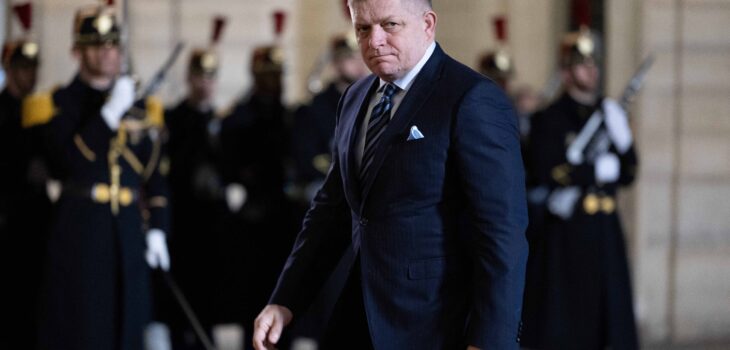
Taken together, the developments are further worrying signs of intensifying efforts by the government Prime Minister Robert Fico to wield greater control over key institutions in the country’s media landscape. They succeed previous warnings by MFRR partners regarding encroaching media capture and require more forceful EU opposition under EMFA.
The current legislative proposal, passed in the first stage in early February, was submitted by MPs from the Slovak National Party (SNS). It would transform Slovakia’s current regulator, the Council for Media Services (RpMS), from a collective nine-member body into a single-headed authority renamed the National Media Office. The draft was introduced as a parliamentary proposal without any prior consultation process or expert discussion. Under the proposed law, a chairperson, appointed and removable by parliament, would hold most regulatory powers. This includes the authority over internal rules and the appointment of a deputy, while the current position of chief executive would be abolished. This restructuring would concentrate decision-making in one individual management position, reducing pluralism and weakening existing checks and balances within the broadcaster. The proposal has now proceeded to a second reading, with a final vote expected in April 2026.
Following our previous fact-finding mission to Bratislava in November 2024, MFRR partners warned that concentrating power in the hands of the chair would undermine the RpMS’s independence and impartiality, and increase government influence over its decisions. Until now, RpMS has been widely regarded as politically independent, with a pluralistic board. However, the governing coalition has in the past year altered the balance within the regulator by appointing six new members to its board, five of whom are persons that have been previously associated with media capture or linked to a government-aligned oligarch or a coalition politician, making the regulator a partially captured body.
Alarmingly, the government has justified the reform as aligning Slovak law with the EMFA. In reality, this bill would move in the opposite direction and weaken the independence of the regulatory body. MFRR partners believe this would directly violate Article 7 of the EMFA and Article 30 of the Audiovisual Media Services Directive (AVMSD), which requires that media regulators be “functionally independent of their governments and of any other public or private entity.”
Concerns over the government’s apparent intention to gain greater control over the operations of the regulatory body have been exacerbated by the recent dismissal of Martin Dorociak, the chief executive of RpMS. Dorociak, who met with the MFRR in November 2025, previously warned about plans to alter the law in ways that would weaken the Council’s independence. On 13 March, this decision was criticised by the European Board for Media Services, an independent advisory body established by the EMFA, which noted that the circumstances of his dismissal, including the sudden proposal and narrow vote, pose “systemic risks” and raise questions about compatibility with EU law.
In addition to the regulatory amendment, MFRR partners are also alarmed by the recent plans announced by the leadership of state broadcaster Slovak Television and Radio (STVR) to reduce staff by around 60 employees. Though justified as purely economically driven, these dismissals include several long-serving journalists and members of a strike committee that previously opposed the abolition of the former public broadcaster Radio and Television of Slovakia (RTVS) in 2024 and publicly criticised the current management of the STVR. Some of these layoffs are being challenged in court for unlawful dismissal.
Our organisations warns these developments appear to be part of a broader effort by the government to remove critical voices from, and solidify greater government influence over, the public broadcaster. Since 2024, changes to the public broadcaster have steadily eroded its independence. The government replaced Radio and Television of Slovakia with a new entity, Slovak Television and Radio (STVR), following significant budget cuts. The latest plans to dismiss journalists, particularly those critical of management, appear retaliatory and politically driven, and risk violating EU standards on public service media independence.
Moving forward, MFRR partners urge Slovak authorities and parliament to refrain from adopting the bill and to respect the institutional and functional independence of the Media Services Council, as required under EMFA. We further call on STVR management to refrain from the discriminatory dismissal of journalists who have taken part in union action or expressed criticism about the public broadcaster reforms or management. Any employment changes must be legal, justified and non-discriminatory.
Considering that Slovakia is currently in pre-infringement dialogue with European Commission under EMFA, the undersigned organisations calls on the Commission to closely assess the latest developments and to take decisive action under the EMFA to protect the independence of media regulatory authorities and public service media in Slovakia, which are crucial pillars of the country’s plural and independent media ecosystem. The situation represents a crucial litmus test of the EU’s new regulatory framework for media, and a test for its commitment to safeguarding democratic values and media independence across its Member States.
This statement was coordinated by the Media Freedom Rapid Response (MFRR), a Europe-wide mechanism which tracks, monitors and responds to violations of press and media freedom in EU Member States and Candidate Countries.