Library

Slovenian government eroding media freedom as it takes over…

Slovenian government eroding media freedom as it takes over EU Presidency

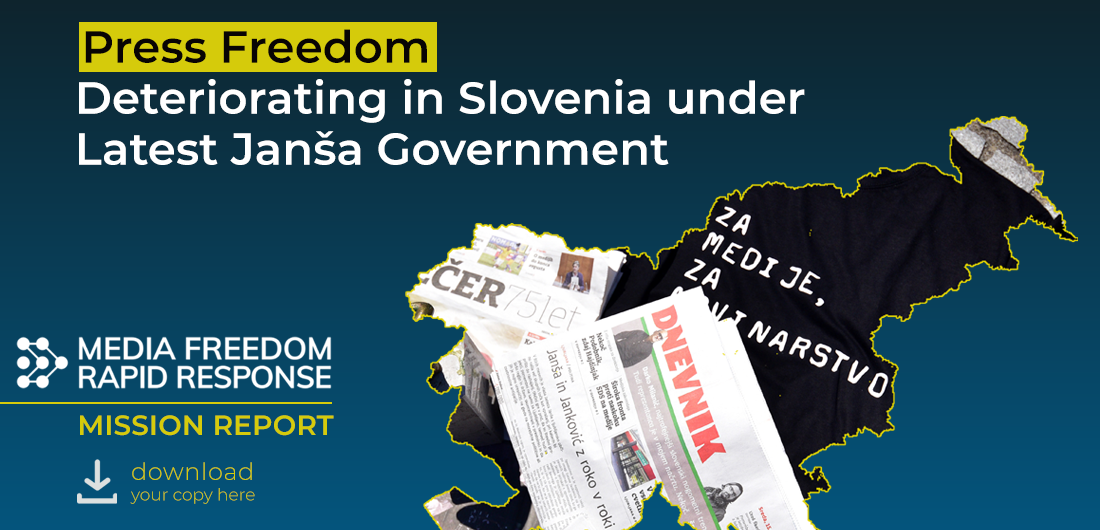
The Slovenian government of Prime Minister Janez Janša is overseeing an increasingly systematic effort to undermine critical media, a coalition of press freedom organisations and journalism groups warn today in a new report.

The report concludes that Slovenia, which assumes the rotating presidency of the EU on July 1, has seen press freedom deteriorate ever since Janša returned to power in March 2020. Since then, the ruling SDS party has embarked on a multipronged campaign to reshape the media landscape in favour of a pro-government narrative, renewing tactics successful during previous administrations and forging ahead with new forms of pressure.

The front line of this campaign is an aggressive attempt to seize greater control of the country’s public service broadcaster and national news agency using a mix of legal and administrative pressure, as well as vicious, often highly personal smears aimed at undermining the integrity and independence of these institutions.

The Slovenian Press Agency (STA), the lifeblood of the media market, has been drained of state funding since the beginning of the year in a calculated effort by the Government Communication Office (UKOM) to subdue the organisation and cement greater control over its financial and managerial operations.

Though the recent announcement that the government will finally pay an advance of €845.000 for 2021 costs is welcome, serious concerns remain over the conditionality of this agreement and its detrimental effects on the independence of the agency. We believe the government is only making this move because of the sustained criticism it has received for its actions and the need to remedy the situation before assuming the EU Presidency.

More broadly, leading government officials, including Janša himself, are stoking the toxicity of public debate by insulting and denigrating journalists – including via official government channels. This inflammatory rhetoric has led to rising self-censorship and an upsurge in threats against the press, both online and offline. Women journalists are particularly targeted with misogynistic and sexist insults.

Behind the scenes, an effort by SDS is underway to limit critical journalism at mainstream media and strengthen a network of partisan outlets linked to the government. Propaganda media are being rewarded with lucrative state advertising contracts, while government officials have sought to pressure editorial offices and reduce challenging coverage at some of the country‘s biggest commercial outlets.

These tactics raise alarm as they reflect elements of the media capture strategy employed by Hungarian leader Viktor Orbán. Moreover, an influx of Hungarian capital linked to Orbán’s Fidesz party is being used to prop up Slovenian pro-government media. Recently, Slovenia’s state-owned telecoms company suspended the sale of a media company after a Hungarian pro-government media outlet was outbid, raising questions about market manipulation and efforts to sell state media assets to SDS‘s political allies in Budapest.

The Janša administration has defended its media policy as necessary to “rebalance” a media landscape it claims is dominated by a historic leftist ideology. Aside from the fact that governments have no business interfering with the editorial lines of media outlets, SDS’ actions and rhetoric do not indicate a genuine interest in fostering greater pluralism but rather in delegitimizing independent media in favour of government-friendly coverage. The depiction of the press as beholden to a political ideology is used to divide the journalistic community down political lines and taint watchdog reporting as biased “opposition journalism”.

While legitimate concerns remain regarding post-independence media ownership concentration and transparency in the Slovenian media market, plans by the ruling SDS party would exacerbate those issues or pose new problems. Legislative proposals to tackle alleged bias at the STA would likewise increase political control over its oversight bodies, rather than lessen it.

While a fragile governing coalition and pushback from civil society and the journalistic community have so far limited the worst of the government’s attempts to erode critical journalism, significant damage has already been caused to the STA and media freedom more widely is once again under sustained threat.

The report follows a two-week online mission to Slovenia carried out by the Media Freedom Rapid Response (MFRR) between 24 May and 2 June 2021. Jointly led by the European Federation of Journalists (EFJ) and the International Press Institute (IPI), it was joined by MFRR members Article 19, the European Centre for Press and Media Freedom, Free Press Unlimited and Osservatorio Balcani e Caucaso Transeuropa. Representatives of Reporters without Borders, European Broadcasting Union, South East Europe Media Organisation and the Public Media Alliance also participated
Library

Slovenia: MFRR calls on Prime Minister Jansa to stop…

Slovenia: MFRR calls on Prime Minister Jansa to stop tweeting insults

The partners in the Media Freedom Rapid Response (MFRR) are dismayed by Slovenian Prime Minister Janez Janša’s disparaging tweet about Council of Europe Commissioner for Human Rights, Dunja Mijatović. On 6 June 2021, Prime Minister Janša said the Commissioner is “part of #fakenews network” in response to her recent memorandum on freedom of expression and media freedom in Slovenia. The Prime Minister’s tweet quoted Mitja Iršič, a public relations expert at the Ministry of Culture, who said their considerations were not properly represented and called the Commissioner’s report “biased and ill-informed.”

We welcome Commissioner Mijatović’ memorandum and share her concerns about the deterioration of media freedom in Slovenia, which align with the findings of our recent fact-finding mission to the country, the report on which is forthcoming. We also note that the Commissioner’s office functions independently and impartially, which we find is reflected in her recent report. Together with the 16-page memorandum, the Commissioner moreover published a 6-page document with comments from the Slovenian authorities, with whom she also met in April during an online dialogue.

We consider the tone and manner in which Prime Minister Janša opted to voice his disagreement with Commissioner Mijatović’ memorandum to be wholly inappropriate for a leader of a democratic European state. The irony of these remarks about a report that expresses concern precisely about the behaviour of public figures, including the Prime Minister, on social media, where they undermine journalists’ credibility “accusing them of lying, and using offensive hashtags such as #fakenews,” is palpable.

The MFRR calls on Prime Minister Janša to cease denigrating the report and instead take action to address its findings. That includes abstaining from making offensive, mendacious or disparaging comments on social media, which contribute to a hostile environment for journalists and media workers in Slovenia and, specifically with regard to the tweet about Commissioner Mijatović, an unwelcome coarsening of the European public debate.

Signed by:

  • Article 19
  • European Centre for Press and Media Freedom (ECPMF)
  • European Federation of Journalists (EFJ)
  • Free Press Unlimited (FPU)
  • International Press Institute (IPI)
  • Osservatorio Balcani e Caucaso Transeuropa (OBCT)
Slovenia Flag - credit: Balkan Photos Library

Who, and why, is surveilling journalists in Slovakia (SME)

Who, and why, is surveilling journalists in Slovakia (SME)

They would go to the bathroom and turn the water tap on, so the water filling the bathtub would make it harder for anyone to hear them talk about serious issues. They knew which rooms to avoid if they wanted to speak of secret meetings and critical texts they were writing. Phone calls were like scenic plays for the state that they knew was listening: Hi, how’s life? Do we need to buy any milk?

In the 1980s, Czechoslovak, Polish, and Hungarian samizdat authors knew the state was actively intercepting them and keeping detailed records of their talks. Civic courage and disobedience were their working methods.

Journalists of the banned publications engaged in their own rituals. They set up meetings in surprising places. They never came to the meetings together, and they left only one by one. Sometimes, before such a meeting, they would buy a train ticket to a small village where they would get off and then secretly return to the city.

They recognised the faces of some of those that followed them. If they met in a café in the suburbs, and noticed anyone suspicious around, they would gesture each other into changing the topics.

The real messages they wanted to exchange they wrote on small bits of paper, only to immediately burn them in the ashtray as soon as they were read. There were ashtrays everywhere; smoking was allowed everywhere back then.

It was clear who listens and why

Editors of the Hungarian samizdat Beszélő protected their sources. They openly published their own names, to make sure the police would focus on them rather than on the people who were helping them, with information or with distribution. The police would regularly raid their homes. They reckoned with that and learned to live with it.

Beszélő was a quarterly publication and the publishers’ main goal was for the state to miss the printing day. And so, not even the editorial team knew where the publication was printed and who the middleman between the editorial and the printing house was.

Some 2,000 pieces of the issue would be divided immediately into packages of 25 and sent around the country. The state always managed to catch at least one or two distributors, but it never managed to dissolve the entire network. The editors never had more than a few copies with them at a time.

In the Gutenberg galaxy

This is how things worked in the world where it was clear who was surveilling journalists and why. Journalists knew exactly what communication channels were connected to the state, they knew the secret service was trying to recruit people from among them, to report on their colleagues.

The snitches continued to act as revolutionaries and criticise the communist state, but in reality they had already crossed over.

This was a system that the communist power openly admitted to on the ideological basis. It was the Gutenberg galaxy with no Googles or Facebooks, where civic courage could weaken the state machinery. Some samizdats managed to remain sustainable for as long as an entire decade.

Too much of a lure?

Today, journalists in working democracies mostly do not expect the state to surveil them. Wiretapping or surveillance without a reason is always the first symptom of the abuse of power and the technological apparatus of the intelligence services. If anything like that comes out, the media ring a loud alarm. And they are right to do so.

Today, the state power no longer requires a snitch, a whisperer or an informant, to be able to find out who thinks what. They no longer need to collect receipts from cashiers to monitor people’s purchases, or secretly sit near their table in a café to hear whether they are badmouthing the government.

They can find out about everything with the potential help of tech companies. They do not boast about it, nor do they cover up these activities with ideology. That is why control mechanisms are necessary to make sure the state does not abuse its technological means against journalists. Because if it dares to do it to the media, then it will easily dare to do it to an ordinary citizen.

The Pegasus scandal has shown how much of a lure a software originally developed for countering terrorism is for governments. For the government of Viktor Orbán in Hungary, among others, which used it to tap into the mobile phones of more than 300 people, including investigative journalists and publishers of independent media.

Does every government tap phones?

In the last 30 years, the Slovak governments followed and wiretapped several journalists.

In the early 1990s, Ivan Lexa led the national intelligence agency, the Slovak Information Service (SIS). Under his lead, the SIS abducted the son of President Michal Kováč. Back then, reasonable people reckoned that the government had all critics of the regime under surveillance. Speaking on landlines, people would greet the undisclosed call participant, imagining them as some rank-and-file state official sitting in a shabby office with his or her headphones on.

With the arrival of mobile phones later on, entrepreneurs would remove batteries from their phones during meetings. Some would go as far as to wrap them in aluminium foil. It was almost like a statement of self-importance, to conspire and to pretend having the phone tapped.

For some, it was more than just a disturbing idea. Under Lexa and the then prime minister Vladimír Mečiar, SIS massively followed and wiretapped journalists.

A change?

Cases of tapping into journalists’ phones appeared also after the fall of Mečiar. For example, the police found in its systems an unauthorised recording of a 2002 conversation between the then economy minister Pavol Rusko and a journalist with daily Sme.

Canadian journalist Tom Nicholson obtained information that the secret services wiretapped his phone calls under the first government of Smer (2006-2010), with Robert Fico as prime minister and Mečiar as one of his two coalition partners. Just because he was a foreigner, the SIS agents wanted to know if Nicholson cooperated with foreign secret services.

The military intelligence service under Ľubomír Galko as defence minister tapped the phones of journalists of the Pravda daily and the head of the private television news channel TA3, with the argument that they wanted to know who leaks classified information to whom.

But the surveillance of journalists only grew into monstrous dimensions with the arrival of the commando that, rather than by the state, was built by Marian Kočner who profited from his relationships with high-ranking public officials and nominees of the then-ruling Smer party.

He had journalists screened through his contacts at the police. Then he hired his friend Peter Tóth to put some of them under illegal surveillance. His commando also followed Ján Kuciak, who later ended up murdered.

What stance will the state eventually take towards such brutal interference with the lives of journalists?

The Pegasus era

There are countries that have leaned away from democracy and that use the “illiberal” label to mask their autocratic traits. They no longer need ideology to justify the surveillance of journalists or opponents.

We are faced with a paradox, when the parliament elected in a relatively free election approves a law for the ruling party to legitimise the use of technology for the surveillance of opponents and government critics. Journalists, too. After all, it has become a routine for government representatives to call journalists the enemies of the nation.

They use technology – mobile phones – that nearly everyone uses in their daily lives.

The existence of critical media and independent institutions plays a crucial role in how such interferences into the lives of journalists or ordinary citizens end. Critical media find out and write about it, while independent institutions then investigate it.

Hungarian government representatives deny the surveillance of journalists. The Hungarian prosecution service announced in July 2021 that they were investigating the use of Pegasus software, but in all likelihood, if Orbán gets re-elected next year, this institution’s investigation will be inconclusive.

If some autocrats manage to grind down the independent institutions in their countries, as is the case in Hungary and in Poland, the effect of the surveillance of journalists and ordinary citizens may be similar as that under communism, but without the state having to build the whole communist-time apparatus anew.

What is worse, traditional tools, like those that the samizdat authors fought by, are not effective in the fight against this new machinery.

This piece is published in collaboration with SME as part of a content series on threats to independent media in Central Europe. Read more.

MFRR 3 consortium logos