Credit: MFRR
Hungary: Media freedom mission welcomes initial reforms, calls for consultations and safeguards for second phase
Media freedom in Hungary has seen significant and rapid changes in the first six months of the new government, marking a historic break with one of the worst crackdowns on press freedom in the history of the European Union. This creates a significant opportunity to rebuild independent and pluralistic media institutions, a delegation of international media freedom and journalist organisations said today.
Speaking at a press conference in Budapest following a fact-finding mission, the delegation concluded that media reforms have taken significant steps towards dismantling captured Fidesz-era institutions, passing important media law amendments, and creating the conditions for restoring independence at the country’s public media and regulatory system.
The first wave of media reform adopted in summer 2026 has introduced significant institutional and legislative changes. However, these early achievements will only be a success if the second wave of legislative reforms effectively addresses some of the outstanding problems Hungarian media and journalists face and if additional safeguards are established to prevent future political interference.
It is therefore crucial that the second and broader package of changes undergo a structured and inclusive expert consultation process with a clear timetable, meaningful input from journalists and civil society, and independent oversight of the implementation of new rules.
Beyond legislative amendments, the government of Péter Magyar should also establish a high-level working group for media with domestic and international civil society and media experts, with clear ministerial focal points for media policy. The government should also adopt a broader approach to supporting the media freedom ecosystem focused on creating an enabling climate for pluralistic and independent journalism.
Public media system reform
Among the positive changes welcomed by the delegation are the passing of amendments to the media law which established new governance structures for the public media. This legislative redesign abolished the state-owned Media Services Support and Asset Management Fund (MTVA) that employed public media staff and controlled its budget and assets, merging it with the public service broadcaster Duna Média into a new company MRTV.
The new law also restored the institutional autonomy of the national news agency MTI and created the Independent Public Media Board. These changes provide a framework for the restoration of an editorially independent and professional public service news. The changes represent indispensable steps toward compliance with the European Media Freedom Act (EMFA) rules on public media. The effectiveness will depend on their implementation.
The delegation praises the work of the Ministerial Commissioner for Public Service Media, appointed by the Minister for Culture and Social Relations, and the interim CEO, for their role in overseeing the transition. The public media system now faces a complex period of restructuring, including a substantial proposed budget reduction and major staffing changes. While financial restructuring may be necessary, decisions on future funding must be based on a clearly defined public service remit and an objective assessment of the resources required to fulfil it, in line with Article 5 of EMFA. Adequate, stable and predictable funding is part of safeguarding the public broadcaster’s functional independence.
The reform process must be transparent and ensure the long-term editorial and functional independence of public service media. New chief executives of MRTV and MTI are due to be selected through open tenders in the coming weeks. The delegation welcomes the ongoing financial audit of public media and its planned publication, which represents an important step towards greater transparency and accountability.
Media regulation and pluralism
The appointments made so far to the Media Council are welcome and provide the country’s media regulatory authority with expert management to guide the coming period of reform. Major priorities for the body must now include action on outstanding concentration and tender issues and the implementation of EMFA rules on the transparency of media ownership and state advertising.
The establishment of a Press Fund, which will be overseen by the Media Council, was also welcomed by mission partners. If properly implemented with strict rules, transparent and objective criteria, and insulation from political bias, the fund could provide a major financial boost for local, regional, minority and investigative journalism. An emergency fund in the next six months must be aimed at providing a financial lifeline to local media, which face an extremely challenging funding climate.
The government’s dismantling of the centralised state advertising system run by the Fidesz-captured National Communication Office (NKOH) has also had a welcome effect on ending the funding of political propaganda. This has weakened the financial foundations of the Fidesz-era media system. However, significant structural distortions and ownership concentration remain, requiring further action to restore fair competition and media pluralism. The next phase of reforms must establish a transparent, objective and non-discriminatory system for allocating state advertising, including advertising by state-owned enterprises, in line with Article 25 of EMFA.
Independent media in Hungary that held the line for years in the face of severe pressure now require support to help them navigate the ongoing market transition. The delegation urges the government to reconsider the proposed reintroduction of the advertising tax, which the Media Council has opposed because of its potential impact on media pluralism, and to conduct an open consultation and comprehensive impact assessment before proceeding.
Legal framework, accountability and additional reforms
In the legal sphere, the dismantling of the Sovereignty Protection Office (SPO) is a highly positive development. The Ministry of Justice’s draft bill on the transposition of the EU’s Anti-SLAPP Directive is a welcome first step to protect journalists and media from abusive litigation. However, the delegation joins Hungarian civil society in calling for the bill to be widened to cover domestic cases, in line with European best practices. While this progress should be welcomed, the delegation was concerned by the lack of progress or apparent political will to address the abuse of GDPR to target critical public interest journalism, a concern that has been widely documented in recent years.
As a result, the second wave of media reforms should include urgent changes to Hungary’s freedom of information framework, including the amending of the Data Protection Act to include exemptions for data processing pursuing a journalistic purpose as provided in accordance with Article 85 of the GDPR – ensuring an effective balance between data protection, freedom of expression and information, and preventing abusive litigation.
The wider landscape for access to information in Hungary has markedly improved, with better access to government press conferences and officials, and a healthier climate for transparency and freedom of information requests to public bodies; though further improvements are still needed.
One area of concern is the lack of concrete progress addressing impunity regarding the use of Pegasus spyware against journalists and others under the former government. In May, the Interior Minister pledged to investigate and disclose politically motivated surveillance ordered since 2010, but no findings have yet been published. Intelligence agencies under its authority have continued to deny journalists access to relevant records. The government must now deliver transparency, accountability and redress. Journalists targeted with spyware must be given access to the files concerning them, those responsible must be held to account, and victims must have access to effective remedies, including compensation.
Overall, the international delegation welcomes the government’s six-month programme for media reform as a breath of fresh air after 16 years of serious democratic backsliding. While these initial steps are positive, the real test is still to come. Independent journalists must be able to operate freely in Hungary, secure in the knowledge that the system is robust enough to prevent any future government from seizing control of the media to undermine democracy. Proper consultation, transparent decision making, effective and independent media regulation, clear ministerial focal points for media policy, and continued political will, are all now essential. The delegation offers the backing of the international press freedom community to secure these long-lasting democratic media reforms.
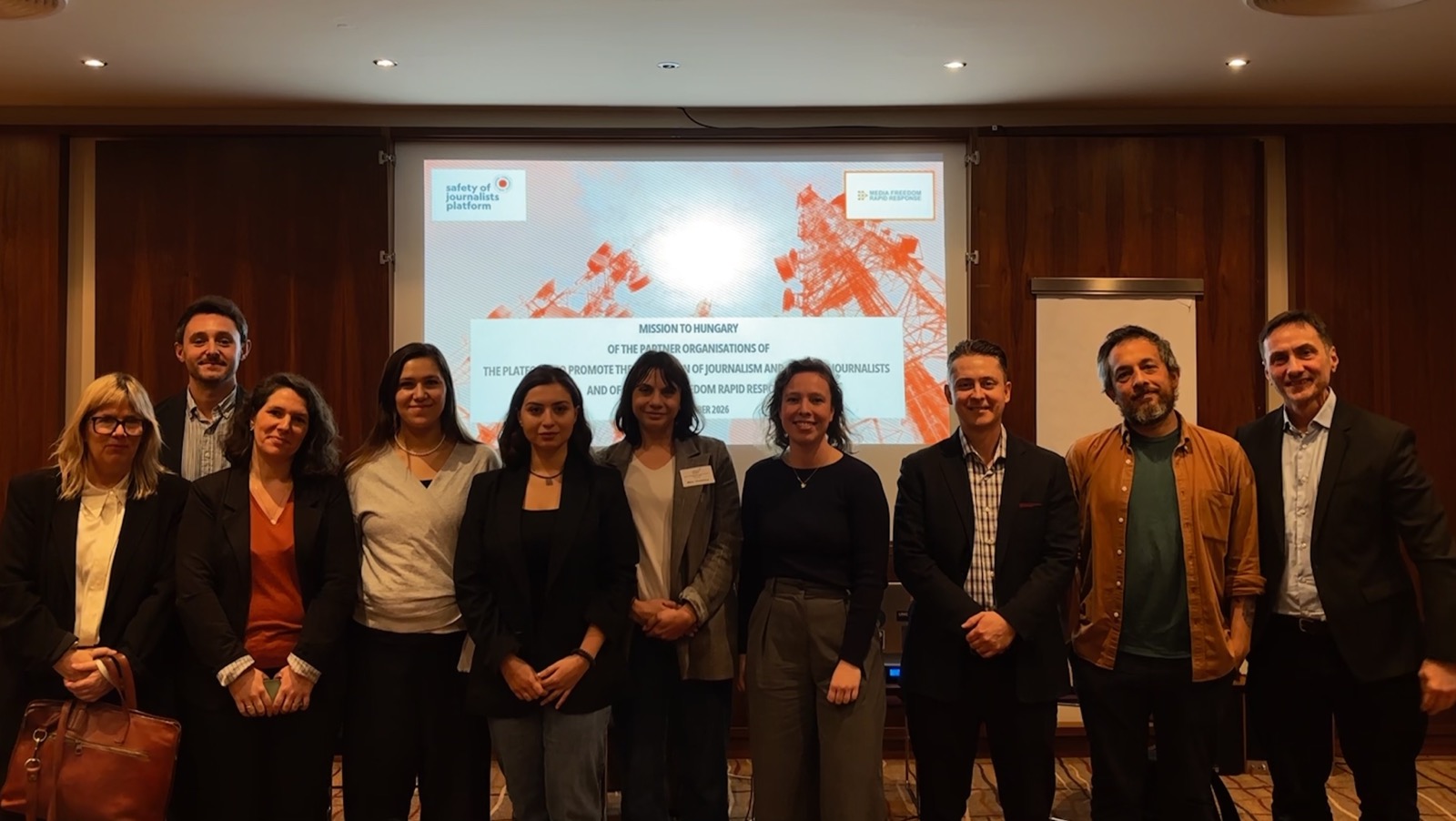
The mission to Hungary was conducted between 4-6 November and was led by the partners of the Council of Europe’s Platform for the Safety of Journalists and the Media Freedom Rapid Response (MFRR).
The delegation extends thanks to all those they met in Budapest. This includes the Ministry of Culture and Social Relations and Ministerial Commissioner for Public Service Media, the Independent Public Media Board, the Media Council, and the National Authority for Data Protection and Freedom of Information, the European Commission Representation, as well as journalists, editors, media associations and unions, media experts and academics, and domestic and international civil society and human rights organisations.
Thirteen organisations took part in the mission: the International Press Institute (IPI), ARTICLE 19 Europe, Association of European Journalists (AEJ), the Committee to Protect Journalists (CPJ), the European Broadcasting Union (EBU), the European Centre for Press and Media Freedom (ECPMF), the European Federation of Journalists (EFJ), Free Press Unlimited (FPU), IFEX, Index on Censorship, the International Federation of Journalists (IFJ), Reporters Without Borders (RSF), and the Rory Peck Trust (RPT).
The delegation held a press briefing in Budapest on 6 November to present its initial findings and recommendations. A full report will be published in the coming months. For press enquiries, contact Jamie Wiseman at jwiseman[at]ipi.media
This statement was coordinated by the Media Freedom Rapid Response (MFRR), a Europe-wide mechanism which tracks, monitors and responds to violations of press and media freedom in EU Member States, Candidate Countries, and Ukraine. The project is co-funded by the European Commission.