picture alliance / Middle East Images | Davood Maeili
France: violence against journalists during protests requires immediate sanctions and implementation of our post-mission recommendations
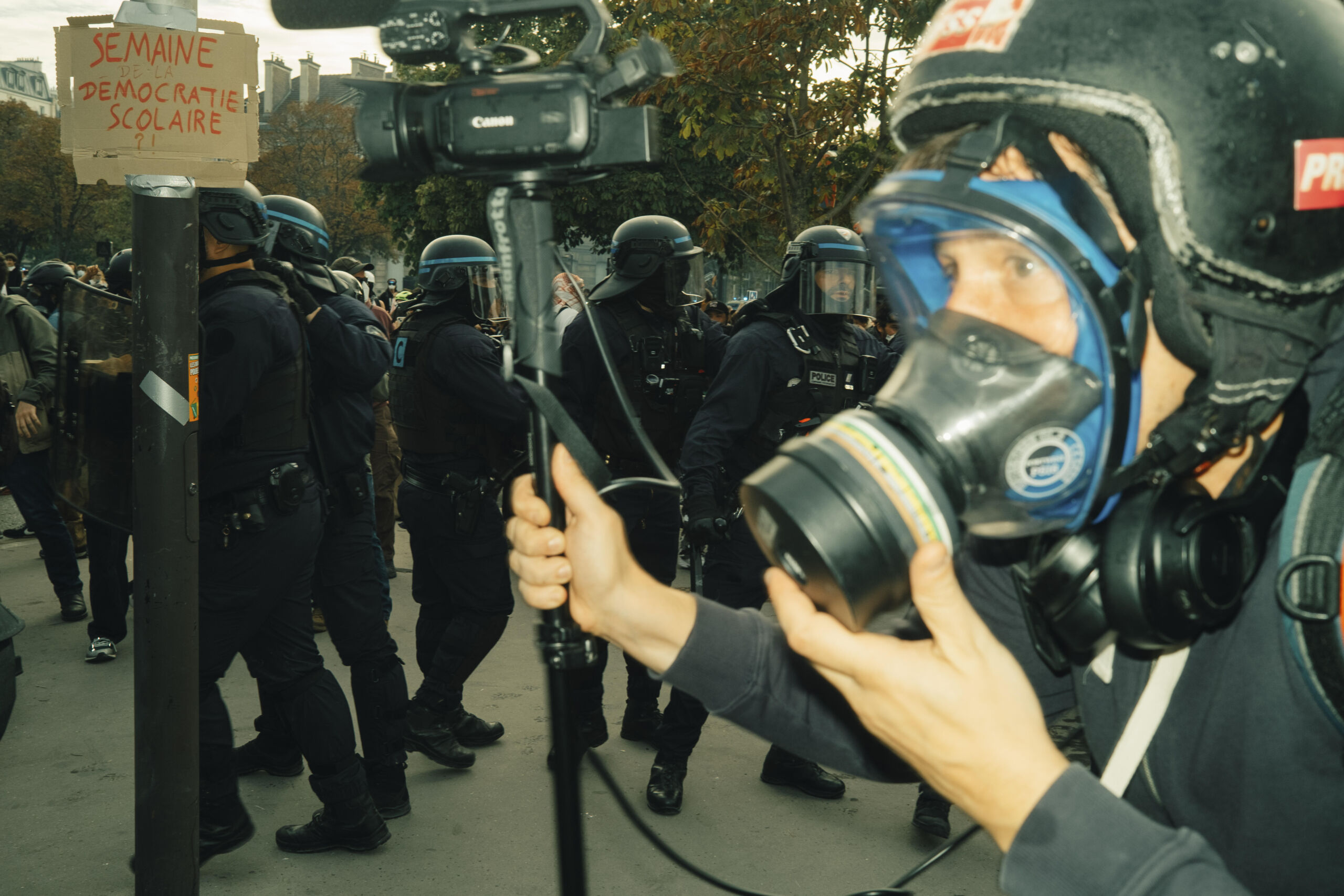
In recent weeks, the European Federation of Journalists (EFJ) has documented more than ten cases of violence and obstruction of press freedom targeting journalists covering student and high school protests in France. More than half of these incidents are attributable to law enforcement officers. Once again, our conclusion is unequivocal: media professionals, even when clearly identified as such, are not safe in the field.
As part of the Media Freedom Rapid Response (MFRR) consortium, EFJ strongly condemns this violence and calls on the competent authorities to identify and sanction those responsible, including law enforcement officers. The Ministry of Justice, the Ministry of the Interior and law enforcement are also urged to take immediate steps to implement the recommendations recently published with our Media Freedom Rapid Response (MFRR) partners and Reporters Without Borders(RSF). These recommendations follow an international mission organised by the EFJ on 9-11 June, during which police violence was identified as one of the main threats to journalists’ safety in France.
Police officers are responsible for most of the documented incidents
Since 29 September, the EFJ has recorded thirteen incidents on the Mapping Media Freedom platform, eight of which were attacks attributable to police riot officers, in complete breach of the National Framework for Public Order Policing (Schéma national de maintien de l’ordre, SNMO).
The incidents in Montpellier are particularly shocking.
On 2 October, Valentin Levetti, publications director of the journalist collective Stup.media, was struck on the right shin by a motorcyclist identified as a plainclothes police officer while he was filming a violent arrest near the Georges-Clémenceau secondary school. Although the rider wore no armband or other insignia identifying him as a member of law enforcement, several elements confirmed that he belonged to the police. In a video shared by witnesses, an officer presenting himself as the head of unit can be heard telling Levetti that “the matter [was] known” and that “the colleague [had been] identified”, before inviting him to file a complaint. Shortly before the incident, the plainclothes officer had repeatedly positioned his motorbike in front of the journalist’s camera. Following the incident, the journalist’s lawyer filed a complaint with the Montpellier Judicial Court. Examined by two different doctors, the journalist was given sick leave. He suffered a haematoma on his right leg and a sprained knee.
Shortly before the incident, Levetti had published several videos showing plainclothes police officers taking part in arrests, as well as uniformed riot police officers from the CRS (Compagnies Républicaines de Sécurité) not wearing their identification number (RIO), in breach of SNMO requirements.
Also in Montpellier, on 6 October, journalist Samuel Clauzier was targeted three times, despite wearing an armband, four press badges and a helmet. The final blow knocked him to the ground, sending his equipment flying several metres. The same day, photojournalist Frédéric Munsch was left choking on tear gas. Munsch was clearly identifiable as a journalist and visible to the CRS before the gas was deployed.
Paris also saw numerous scenes of violence. On 6 October, Mike Strachinescu, a journalist with the daily L’Humanité, was grabbed by the throat twice by a CRS officer, even though he had shown his press card to the police. Reporters Without Borders (RSF) also denounced a particularly worrying case on 8 October: photographer Patrick Wack was shot at point-blank range with a less-lethal launcher (LBD, lanceur de balles de défense). Wack was covering a gathering on Place de la Bastille from a distance for the US daily The Wall Street Journal. Injured in the ear, he required stitches.
Other incidents involved a Lyon Mag journalist whose phone was violently knocked to the ground by a CRS officer, and a journalist from the regional daily Var Matin who was struck with a baton by a police officer in Fréjus despite showing his press card.
The confiscation of journalist Anna Margueritat’s protective equipment as she was returning from a demonstration in Paris further adds to concerns about the treatment of the press and the lack of protection afforded to it.
Repeated attacks by protesters forcing journalists to withdraw from the mobilisations
Several assaults on journalists committed by individuals during demonstrations have been denounced by numerous newsrooms.
On 1 October in Marseille, the channel M6 denounced an attack on its correspondent and the destruction of his camera. In Manosque, a journalist from BFM DICI, the 24-hour news channel’s local outlet for the Southern Alps and Haute-Provence, had to be escorted out of the protest after being confronted and pushed around. On 29 September, BFMTV journalists were also insulted and assaulted in Saint-Denis, while in Lille two LCI journalists were targeted with, among other things, glass bottles, and narrowly avoided iron bars. Finally, in Dijon, a journalist from the outlet Dijon Actualités was threatened with a knife, prompting the newsroom to stop covering the protests.
The EFJ calls for the urgent implementation of its recommendations
As threats intensify ahead of the demonstration announced for 17 October, the EFJ and its French affiliates call on media professionals to equip themselves with protective gear and to know their rights and duties as set out in the SNMO. Police officers are also urged to respect the SNMO, which notably requires them to wear their RIO visibly. The practice reported by Ministry of the Interior representatives met during the mission, whereby no disciplinary action is taken in the absence of a court ruling finding the officer guilty, must end. Any police officer responsible for a breach of duty must be held accountable in accordance with the law.
An attack on a journalist is an attack on democracy.
All obstruction of and violence against journalists will be reported to the Mapping Media Freedom platform and to the Council of Europe Platform for the Protection of Journalism and Safety of Journalists.
This statement was coordinated by the Media Freedom Rapid Response (MFRR), a Europe-wide mechanism which tracks, monitors and responds to violations of press and media freedom in EU Member States, Candidate Countries, and Ukraine. The project is co-funded by the European Commission.