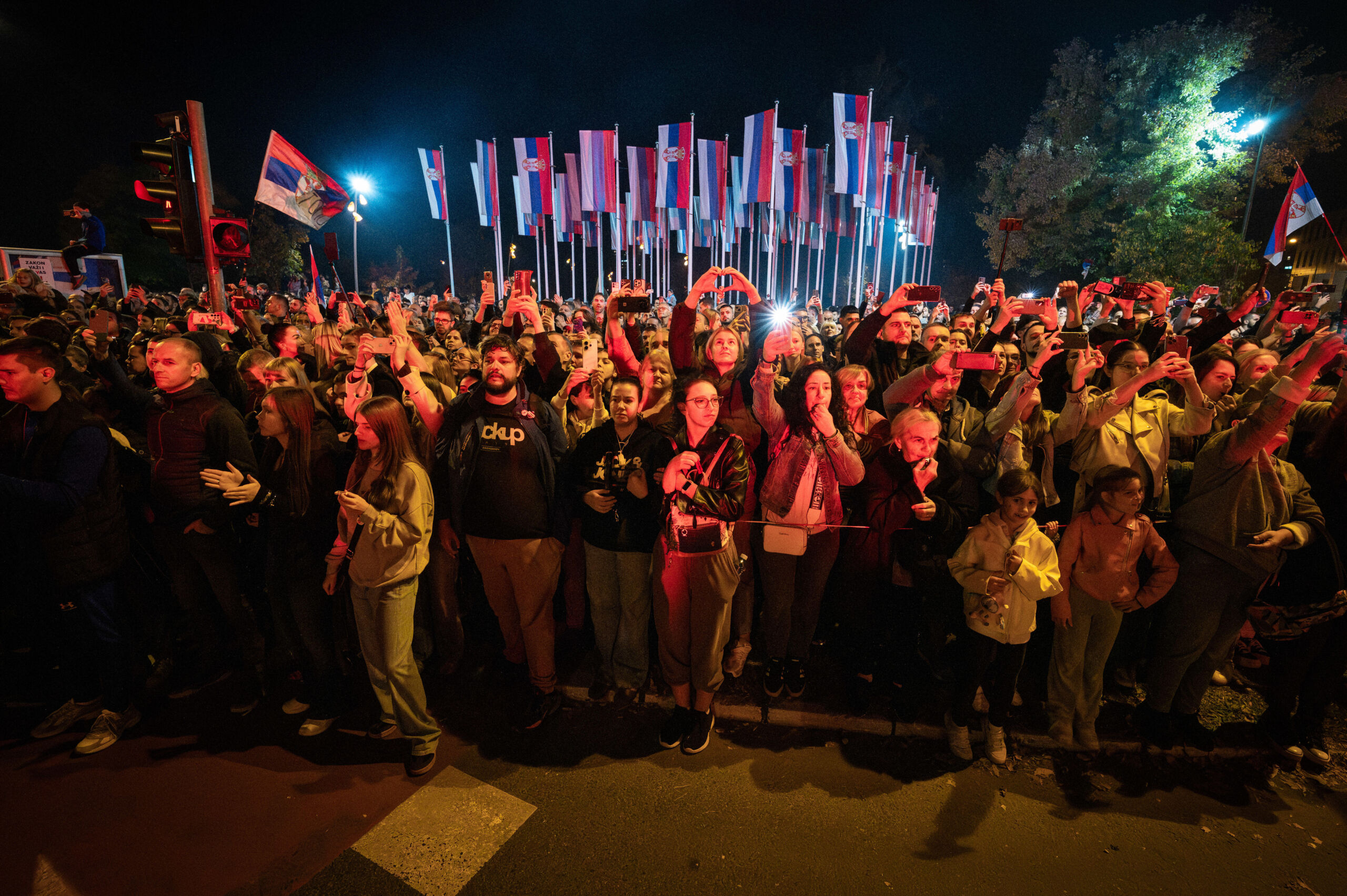
picture alliance / ZUMAPRESS.com | Daniel Alfoldi
Serbia: Spiral of violence against journalists intensifying in total impunity
The undersigned organisations raise alarm over the spiral of violence against journalists in Serbia that has intensified over the past weeks. Since our international mission to Belgrade in March, online death threats and threats of sexual violence targeting independent media professionals and their families are flourishing with near-total impunity.
The undersigned organisations urgently reiterate our calls on Serbian authorities to put an end to the climate of impunity by prosecuting those who attack media professionals, refraining from the use of dangerous rhetoric, and publicly denouncing any attempt to silence public interest reporting.
While the Serbian authorities have responded more actively to the press freedom violations documented on the Council of Europe Platform to Protect Journalists, since the mission, these responses have not accurately reflected the scale of the issue, led to meaningful action and some have not been addressed by the relevant authorities. In light of the most recent response, which once again failed to condemn threatening remarks made by state officials, the undersigned organisations are urging the authorities to treat the alerts with the seriousness they deserve, to sanction violations of press freedom, and to ensure the protection of journalists who have been dehumanised for far too long.
Since the beginning of this year, the Mapping Media Freedom platform has recorded 31 online death threatstargeting 44 media professionals.
Prominent figures such as Association of Independent Electronic Media (ANEM) President Veran Matić, Danas columnists and ‘Dobar Loš Zao’ podcast hosts Marko Vidojković Nenad Kulačin, journalist Dinko Gruhonjić and Radar Predrag Simonović face near-daily harassment, also involving threats against their families and children. Veran Matić, who was portrayed as an “enemy of the state” on primetime broadcast and was recently attackedin the street, was threatened this month with online threats stating he should be “left for dead and torn apart by animals” and his head should be “cut off”. Threats against journalists Marko Vidojković and Nenad Kulačin alone account for at least six death threats recorded. Their mothers were also threatened online with sexual violence, as was Kulačin’s daughter last year. Among the nineteen family members affected, a comment addressed to the newly appointed N1 News Director Branislav Šovljanski was particularly violent, reading: “we’ll f*** your children, your family, everything you have, and we’ll do it slowly.” Threats of sexual violence were also made against the young child of Predrag Simonović, a former police inspector and columnist for Radar Weekly, who was himself regularly threatened, including with death.
The state authorities and political actors who have incited and spread hatred against these media professionals bear responsibility for the daily threats they face. Despite repeated promises to both European institutions and civil society, authorities continue to fail to prosecute the perpetrators of attacks, even in cases where the perpetrators have been identified. Several journalists have been forced into exile due to safety concerns, such as Marko Vidojković and, most recently, freelance journalist Aleksandar Radić.
Violence is not limited to well-known journalists; local journalists, who are more visible and vulnerable in their communities, face even greater risks.
The recent beating of Professor Stevan Filipović in Belgrade, in front of several witnesses, clearly shows that politically motivated physical violence is increasingly prevalent in Belgrade. The destruction of the car of the son of journalist and program director at the Independent Journalists’ Association of Vojvodina Dinko Gruhonjic was also of particular concern. Independent journalists are no longer safe in Serbia. As long as attacks remain unpunished, media professionals are at higher risk than ever of being attacked or even killed.
This pattern of impunity extends to the justice system as a whole. In 2025, only three convictions of those responsible for criminal attacks on journalists were secured by judicial authorities. The ongoing impunity in the killing of Slavko Ćuruvija, alongside the unpunished murders of Dada Vujasinovic and Milan Pantic, highlights the systemic failure of the criminal justice system, in addition to the broader erosion of the rule of law.
Amidst the escalation of violence, the undersigned organisations reiterate our call on authorities to treat cases with the seriousness they deserve. While it is welcome that Serbian authorities have become more responsive in cooperating with the CoE platform, these responses rarely signify an actual effort to address the cases flagged. No cases have yet been resolved in 2026.
Further to this, questions remain as to whether a series of recent alerts were addressed by the relevant authorities. For instance, the official reply from the Republic of Serbia’s General Public Prosecution dated 17 August, regarding discrediting and threatening remarks made against journalists during a parliamentary debate, is deeply concerning. Instead of acknowledging and denouncing the threatening nature of the statements, especially the statement by the Minister of Culture that “something bad should happen to Gruhonjić,” referring to the journalist Dinko Gruhonjić, the response, authored by the prosecution, focused solely on the fact that ‘denigration’ is not prosecuted ex officio under the Penal Code, a legal technicality which has never been disputed. Such a response is not just disappointing; it yet again reflects the ongoing impunity on the ground and the urgent need for state officials to speak out.
Media professionals must no longer be subjected to, or be considered as legitimate targets of public persecution.
Signed by
- European Federation of Journalists (EFJ)
- Free Press Unlimited (FPU)
- Osservatorio Balcani Caucaso Transeuropa (OBCT)
- European Centre for Press and Media Freedom (ECPMF)
- International Federation of Journalists (IFJ)
- Index on Censorship
- Reporters Without Borders (RSF)
- Association of European Journalists (AEJ)
This statement was coordinated by the Media Freedom Rapid Response (MFRR), a Europe-wide mechanism which tracks, monitors and responds to violations of press and media freedom in EU Member States, Candidate Countries, and Ukraine. The project is co-funded by the European Commission.